
Classroom Activities in the Age of GenAI
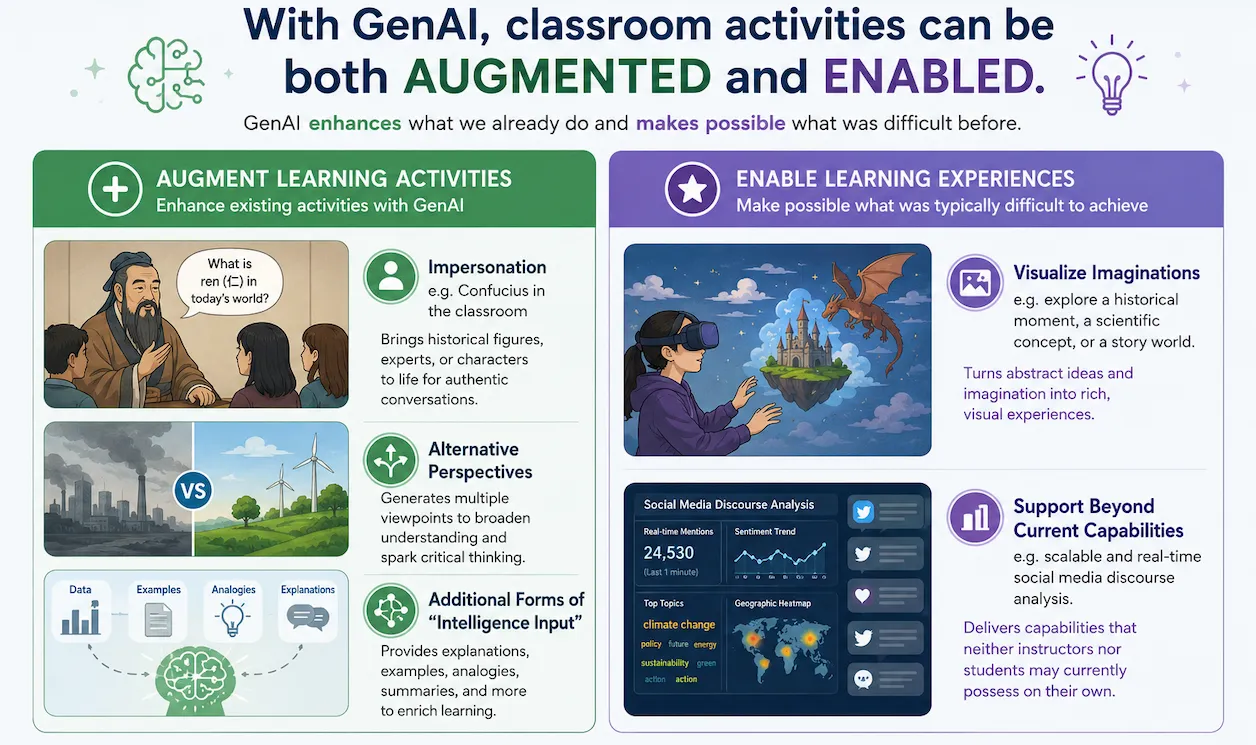
However, classroom activities should be designed to help students develop and practice the knowledge and skills that will later be demonstrated in assessments. A key consideration here is that integrating GenAI in classroom teaching needs to be purposefully aligned with learning objectives and enhance student learning, rather than simply for novelty. Instructors should clearly communicate the rationales to students as well. A primary educational reason for using GenAI in the classroom is that it creates teaching opportunities to develop students’ AI literacy under the guidance of the instructor. Students can observe how professors and peers craft prompts, critically evaluate AI-generated outputs, engage in iterative refinement, and understand how GenAI can be leveraged to enhance human thinking, creativity, and decision making.
At the same time, GenAI challenges some of the underlying assumptions behind traditional classroom activities. Discussion prompts, personal reflections, even spontaneous in-class questions can now be answered instantly by GenAI and read aloud by students. In many cases, instructors will recognize AI-generated responses, but the more important consideration is to design activities intentionally so that the cognitive processes originally meant to support learning remain essential, rather than being bypassed through structural shortcuts enabled by GenAI.
Using GenAI in the Classroom Ideas & Examples
Real-time response analysis: AI analyzes student posts, discussion responses, or quick writes in real time to identify common patterns, misconceptions, and key insights across all submissions.
Group work synthesizer: After group work or collaborative activities, AI tools can analyze photos of group whiteboards, worksheets, or notes to identify common themes and differing perspectives across groups.
Think-Pair-Share: Students pair with another person in class and/or with an AI tool.
Jigsaw: Students can be asked to learn about a particular topic first using AI-generated content, then fact-checking that content, adding to it, and exploring other sources information to create an extended learning experience that is then shared with peers.
Debate: AI as a debate partner for students to practice and reduce anxiety
Role-play+Debate: AI can simulate debate opponents, historical figures, or other perspectives, allowing students to practice arguments and test ideas before a live debate.
Voice-cloned discussion facilitators: AI voice bots serve as discussion participants or guides, representing different perspectives, historical figures, or the instructor.
Policy dilemma simulations: Political science or ethics instructors can organize policy simulation exercises where student teams analyze social dilemmas in different national or cultural contexts. Students can create custom GPTs representing different stakeholders or perspectives to debate complex social and policy issues.
References
- Examples & Ideas for Using AI for Your Teaching. Derek Bok Center for Teaching and Learning, Harvard University
- GenAI library: Activities for the classroom. Learning design and assessment, The University of Melbourne
- Designing Assignments to Work with AI. Digital Education and Learning Technology Applications, NC State University
- Generative AI in the Classroom. Center for Integrated Professional Development, Illinois State University
- 5 Engaging AI Classroom Activities to Try With Your Students
- Optimizing AI in Higher Education: SUNY FACT² Guide, Second Edition
- Writing Across the Curriculum: AI-Based Assignments and Activities. Weitz Center for Creativity, Carleton College