
- Integrate AI tools for teaching specific content or skills
- Guide students in using AI for academic, research, and creative work
This teaching case examines how AI tools can be integrated into humanities instruction to support students’ engagement with complex primary sources. It focuses on the use of large language models to assist students in academic translation while reinforcing critical reading, contextual reasoning, and interpretive judgment.
Course Context and Pedagogical Rationale
When teaching HIST 217: Arts of China in S3 2024, one of the central thematic foci was Dunhuang (敦煌). The course emphasized its art, manuscripts, and devotional records. A major challenge for nearly all students was reading and interpreting ancient Chinese texts with fluency and confidence.
To address this difficulty, I designed a multi-stage translation exercise that foregrounded human interpretation before introducing AI assistance. Students were first asked to translate selected passages from Chinese into English in pairs, deliberately matching one native speaker with one second-language learner. After completing an initial draft, each pair shared their translation during a class discussion. This process allowed students to compare interpretations, debate ambiguities, and collectively refine their understanding of the text.
Only after this sustained engagement with human-generated translations did I introduce ChatGPT as a supplementary tool. I made it explicit to students that prompt engineering is, and will continue to be, an essential scholarly skill. Students were instructed to consult ChatGPT critically and then produce a revised translation that reflected their own judgment in dialogue with both peer feedback and AI-generated output. We concluded with a second class discussion focused on evaluating the strengths and limitations of the LLM-assisted revisions.
Example: Dunhuang Votive Text Translation
Below is the original Chinese votive inscription from a Dunhuang silk banner, followed by a student’s revised English translation developed in reference to faculty guidance and ChatGPT’s suggestions.
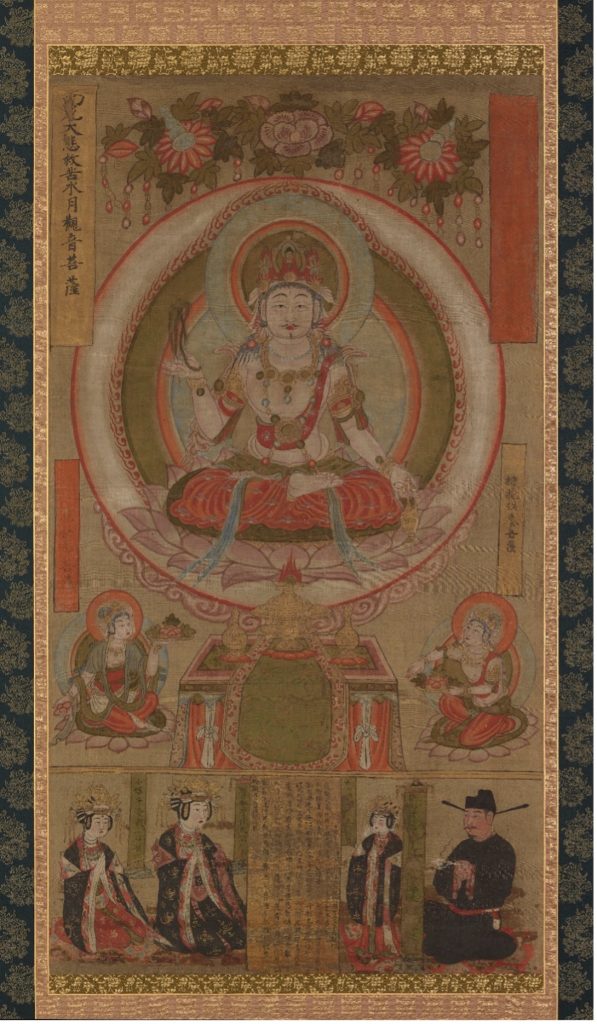
《繪觀音菩薩功德記》
竊以弥陁上足号觀音焉,願力難思,慈□普極,分形種類,救苦毒於三[塗],現化[多] 門,[祅?]幽趣於六道,是施无畏者急難消除,有識虔誠盡繪者矣。即有我娘子以男司空,為新婦小娘子難月之謂也。伏以司空,星辰降瑞,江海呈祥,伇紫毫而八體宛然,彎素月而六鈞有異,遂乃發一心願,敬畫真容,具相嚴[成],丹彩已就。伏願娘子以司空承斯緣善,福祚壽松柏之年;小娘子共男郎君賴此勝因,祿寵[等]龜鶴之載;然後金枝九族,玉[葉]一宗,咸[外?][良]緣,齊登覺路。 于時乾德六年歲次戊辰五月癸未朔十五日丁酉題紀。
Record of Merits for Painting the Bodhisattva Avalokiteśvara
I humbly submit that among Amitābha Buddha’s foremost attendants is the one known as Avalokiteśvara. The power of his vows is beyond comprehension. His compassion extends universally to the utmost limits, manifesting in diverse forms and kinds. He rescues beings from the suffering and torment of the Three Paths, reveals manifold modes of transformation, and guides those lost in the dark destinies of the Six Realms. As the Bestower of Fearlessness, he swiftly dispels urgent calamities. Thus, those endowed with awareness and sincere devotion have fully rendered his image in painting.
Accordingly, I, the lady, together with my son, the Sikong (Minister of Works), make this dedication on behalf of the young lady, his wife, during the difficult months of her pregnancy. We respectfully acknowledge that the Sikong, under whom the stars descend with auspicious signs and the rivers and seas present favorable omens, wields the purple rabbithair brush so that the eight script styles appear with clarity, and bends the white crescent moon with a strength of six jun, remarkable in its distinction. Thereupon, with singleminded resolve, we gave rise to this vow and reverently painted the true likeness. The iconographic features have been completed with solemn exactitude, and the vermilion pigments have now been fully applied.
We humbly pray that the lady, through the Sikong, may receive this virtuous karmic connection and enjoy blessings and longevity equal to the years of pine and cypress. May the young lady and her husband rely upon this superior cause to receive rank and favor, enduring for as long as the tortoise and crane. Thereafter, may the nine branches of the golden lineage and the single clan of jade leaves alike encounter wholesome affinities and together ascend the path of awakening.
Inscribed and recorded on the fifteenth day of the fifth month of the sixth year of the Qiande reign, the cyclical year wuchen, corresponding to the day dingyou.
Outcomes and Observations
This exercise revealed that ChatGPT has developed a striking level of competence in syntactic analysis and lexical indexing. Words and phrases that students struggled to interpret were often translated accurately and efficiently by the model, particularly in cases involving formulaic religious language or conventional epigraphic expressions.
At the same time, we observed consistent weaknesses. ChatGPT frequently confused or misassigned grammatical subjects. This problem was especially pronounced in ancient Chinese texts, where subjects are often omitted and must be inferred contextually. Educated human readers rely on cultural knowledge, genre conventions, and narrative logic to reconstruct these implied agents. These are capacities that remain difficult for large language models to replicate. This limitation proved pedagogically valuable, as it clearly demonstrated that, at its current stage, AI cannot substitute for nuanced human interpretation.
Challenges and Lessons Learned
One concern that emerged was a tendency among some students to develop an overreliance on large language models. The ease of generating an answer with a single prompt can discourage sustained critical thinking if not carefully framed within a structured learning process.
I also noticed a near subconscious trust in machine-generated output. Some students appeared to regard AI responses as inherently more reliable than human interpretations. This attitude likely reflects habits formed during the search engine era, when tools such as Google offered a scope and speed of information retrieval far beyond individual human capacity. Such experiences can foster an implicit belief in technological authority, even when interpretive judgment is required.
By explicitly foregrounding AI’s limitations alongside its strengths, this assignment aimed to counteract that tendency and reinforce the importance of human reasoning, contextual sensitivity, and scholarly responsibility.