
Active learning involves “students in doing things and thinking about the things they are doing” (Bonwell & Eison, 1991), which can be achieved through instructional approaches that engage students in higher-order thinking processes, such as applying, analyzing, evaluating, and creating. Activities like explaining ideas in their own words, discussing complex questions, problem-solving, and making decisions deepen students’ understanding and develop their skills with timely feedback from instructors and peers.
DKU Examples in Teaching Stories
- Hyun Jeong Ha: Role-play Debate – Wear a Different Hat and Encounter New Challenges
- Chuanhui Gu: Students Generating Questions as a Way of Active Learning
- Zach Fredman: Making History Real: Role-Playing Games as Pedagogy
- Xiaochen Zhang: Use interactive polling as classroom assessment
- Engaging and interactive teaching in language class: Junyi Li: 2024 DKU Undergraduate Teaching Award Winner
- In-class discussion and debate: Chia-Chien (Eric) Chen: Preparing Students for Their Futures: Building Disciplinary and Transferable Skills
*This is not an exhaustive list of DKU examples. We are happy to collect more examples and implementation ideas for specific activities in DKU classroom.
A Holistic View
From a more holistic view of active learning, an effective set of learning activities is one that includes receiving information and ideas (e.g., through lectures or textbook readings) as well as opportunities for experience and reflection in a variety of ways.
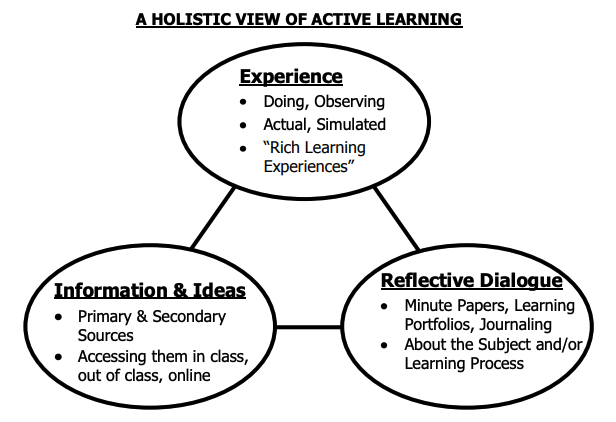
Two guiding principles for selecting learning activities:
- Incorporate all three components of active learning.
- Prioritize direct forms of active learning whenever possible, while using indirect or vicarious forms when necessary.
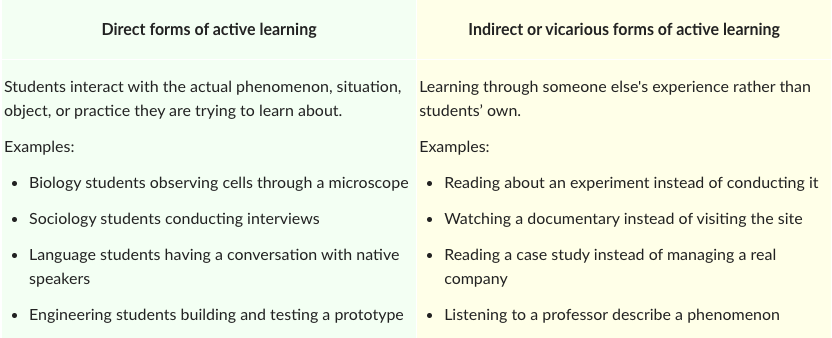
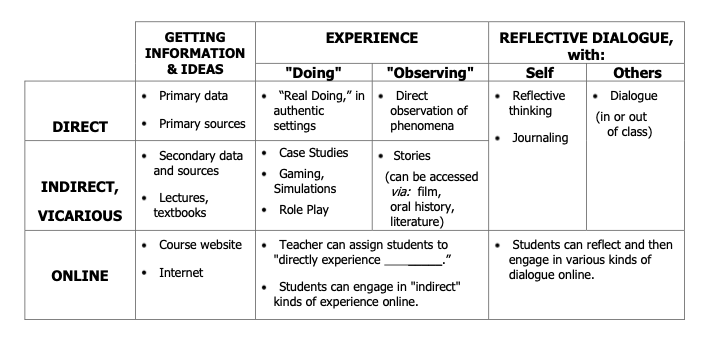
The table below provides examples of how instructors support students in receiving information and ideas, engaging in experiences, and participating in reflective dialogue through direct, indirect (vicarious), and online/out-of-class learning experiences.
Implementation in the Classroom
Meaningful engagement: Make sure active learning activities are intentionally designed to align with learning objectives, rather than being used solely for engagement. In other words, they should help students develop the knowledge and skills they are expected to demonstrate in assessments and provide meaningful opportunities for practice and application.
Class dynamic and rhythm: Repeating certain activities regularly can establish a rhythm and help students know what to expect. Introduce one new activity each class rather than implementing too many at once.
Modeling plays an important role in helping students succeed. Demonstrating how to complete an activity or providing examples can help students more quickly understand expectations and participate effectively in the activity.
Grouping: Purposefully formed groups, created through a structured grouping process, such as instructor assignment or grouping students based on shared interests, topics, skills, or project goals, often lead to more effective collaboration than groups formed entirely through student self-selection. Consider group size, try different grouping strategies, and encourage balanced participation and workload distribution by assigning specific roles (e.g., note-taker, reporter, facilitator) and rotating these roles among group members.
Classroom environment and logistics: Some activities may require specific classroom layouts, seating arrangements, or additional materials such as flipcharts and markers. Consider planning these logistical needs in advance and reaching out to campus operations for support if needed.
Additional preparation and flexibility: Some activities may need advance testing, additional preparation time, or supporting materials (e.g. worksheets). During implementation, timing may shift, students may encounter challenges, or certain steps may require further explanation. Having a contingency plan and being prepared to adjust in real time can help ensure a smoother learning experience.
Talking to Students about Active Learning
DKU students usually expect opportunities for discussion and interaction and are generally willing to participate and collaborate in class. However, given their diverse academic and cultural backgrounds, personalities, and levels of readiness, it is strongly recommended that instructors clearly and transparently communicate how active learning activities will be implemented and why.
- Communicate expectations early: In the syllabus or on the first day of class, provide students with an overview of how the classes will be organized, especially about the active learning components, so they can come prepared and understand what to expect.
- Provide clear instructions and scaffold participation: Some active learning activities involve multiple steps and may be unfamiliar to students (e.g., Jigsaw). Break activities into manageable steps and gradually build complexity, especially when students are engaging in them for the first time. Clearly explain what students are expected to do, the level of expected performance, the time allocated, and where they can find resources or additional support. Regularly check in with students to address questions, confusion, or distractions.
- Explain the purpose and encourage reflection: Explicitly communicate why the activity is beneficial and how it connects to future academic, professional, or real-world applications. When appropriate, share relevant research or evidence supporting the effectiveness of the activity. Encourage students to reflect on what they learned and how the process contributed to the development of their thinking, collaboration, and learning skills.
References
- Bonwell, C. C., & Eison, J. A. (1991). Active learning: Creating excitement in the classroom. ASHE-ERIC Higher Education Reports. (1). Retrieved from https://files.eric.ed.gov/fulltext/ED336049.pdf
- Fink, L. D. (2003). A Self-directed Guide to Designing Courses for Significant Learning. San Francisco: Jossey-Bass.