
Oral and Written Assignment Redesign: Video-based Self-reflection on Writing Process
Context
I teach EAP courses and a 2CWC course at Duke Kunshan University. Throughout my observation, students in these courses often lack a clearer understanding of their strengths and weaknesses in writing and language learning, as well as of other knowledge and regulations that support their transition to other classes. While the growing presence of AI tools is observed in students’ academic writing processes, increasing concerns have been raised about redesigning assessment to help students develop awareness, judgment, and control over their writing.
Purpose and Redesign
The EAP team at LCC redesigned the goals for EAP101B to emphasize the writing process and the reflective component of assessment. As part of this redesigned approach, students were asked to complete a 5–7 minute video-recorded reflection, rather than relying solely on a written reflection. In these videos, students explained:
- What they revised
- Why they made those changes
- How they used feedback and the rubric
- What they hope to improve in the future
This reflection-oriented assessment shifts the focus from retelling to thinking aloud about revision decisions, allowing faculty to see students’ metacognitive processes, not just the final written product.
Student Sample
The following screenshots demonstrate how students proceed with this type of assessment. The sample was contributed by student Zhitao (William) Wang, Class 2029.
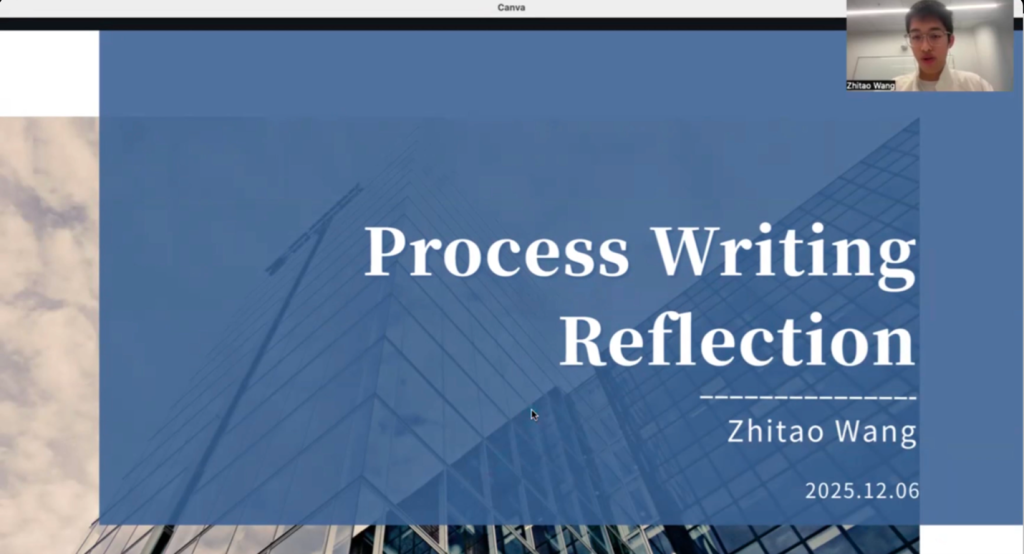
Screenshot 1. Student info and the view of the video
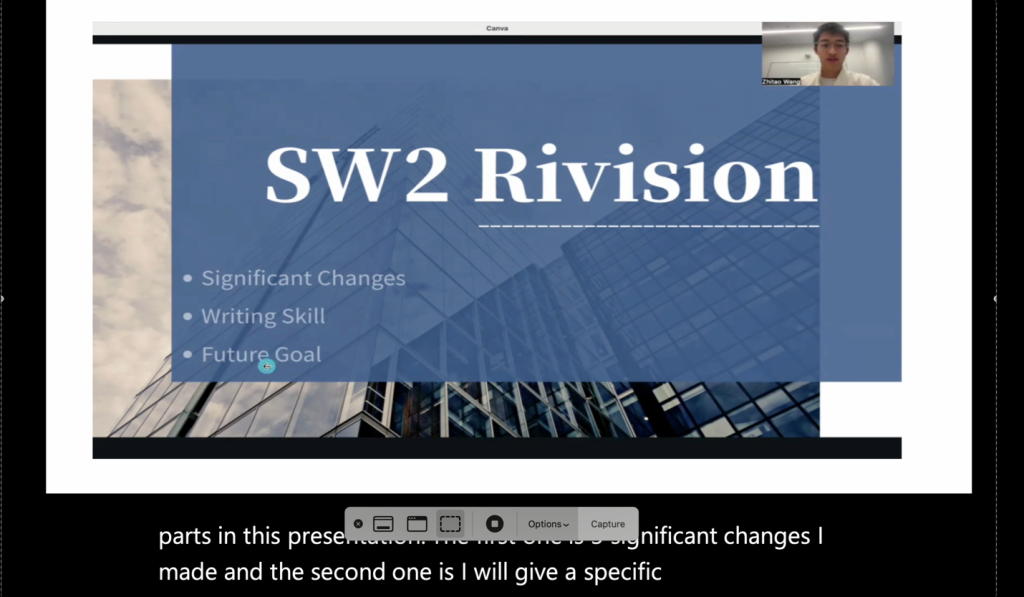
Screenshot 2. The student introduced the agenda of the reflection.
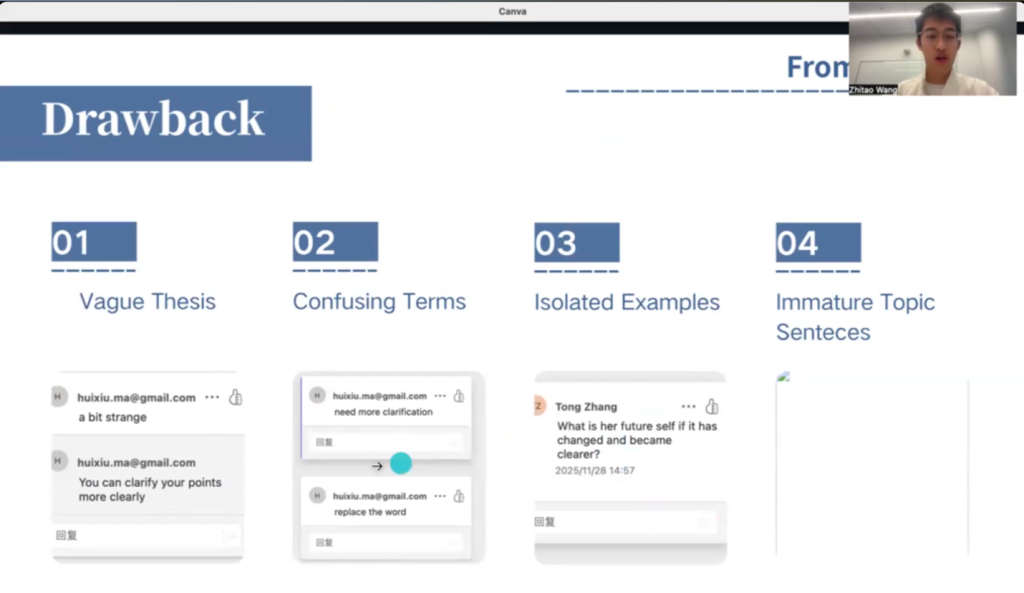
Screenshot 3. The student reflected on how he identified the drawbacks in this writing, and used peers’ and the professor’s feedback to explain the identification process.
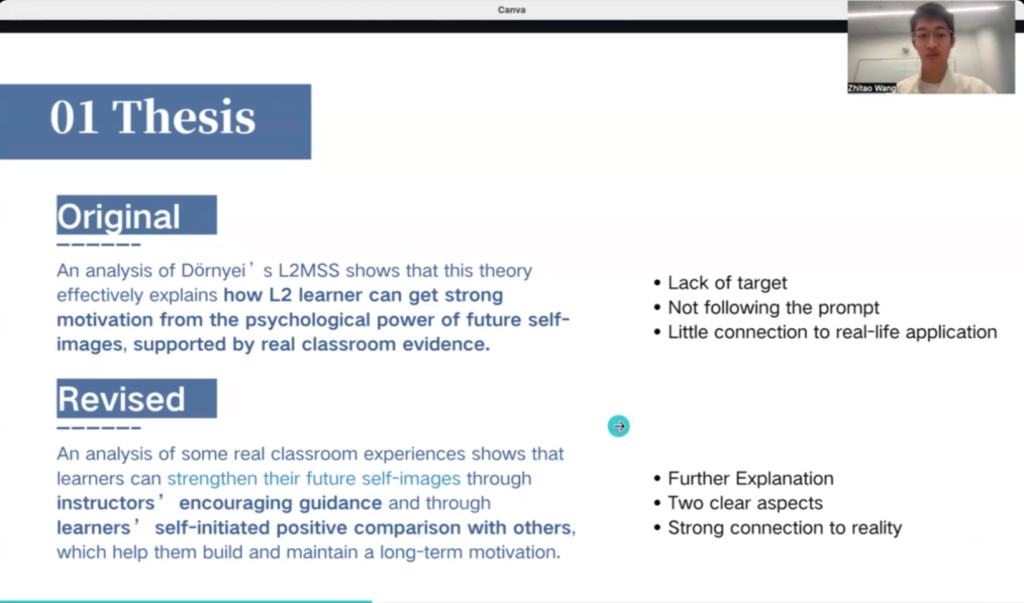
Screenshot 4. The student showed a deeper analysis of issues in his draft and the improvement he made in the revised version.
Screenshot 5. Moving beyond the scope of one writing assignment, the student demonstated metacogntive awareness in analyzing his success and failure in the personal approach to composing the argument.
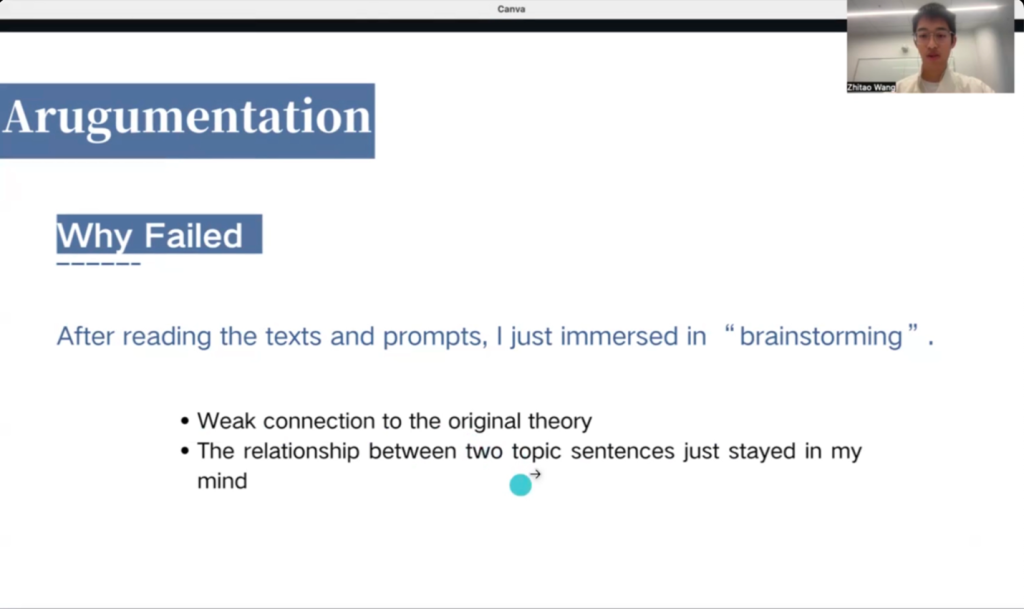
Screenshot 6. Another example of how the students metacogntively aware of their successful use of strategies based on a refined understanding of the affordances and constraints of the assignment.
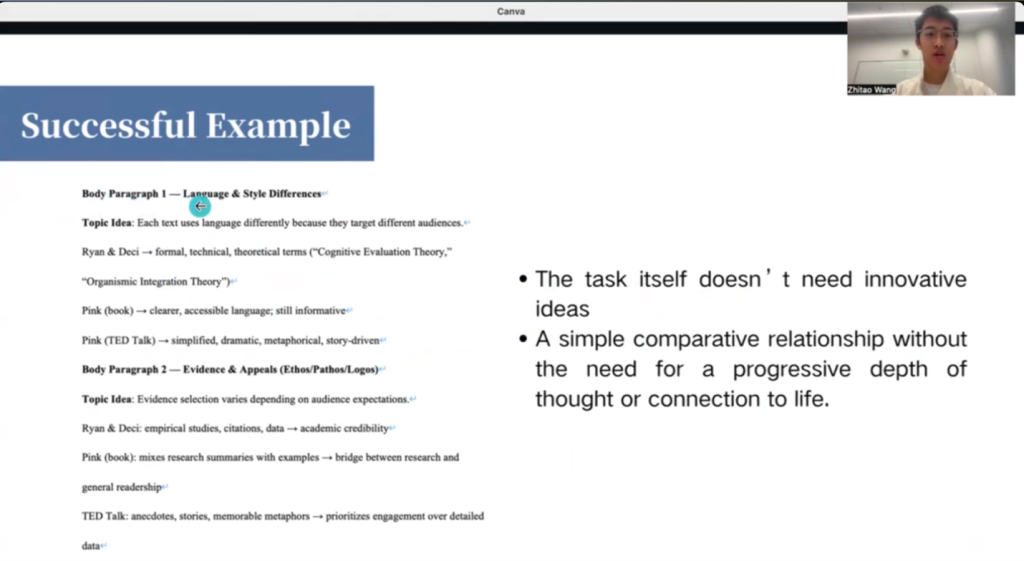
Screenshot 7. Here, the student moved to a deeper reflection on summarizing the changes in his understanding of effective writing strategies to write an argument.
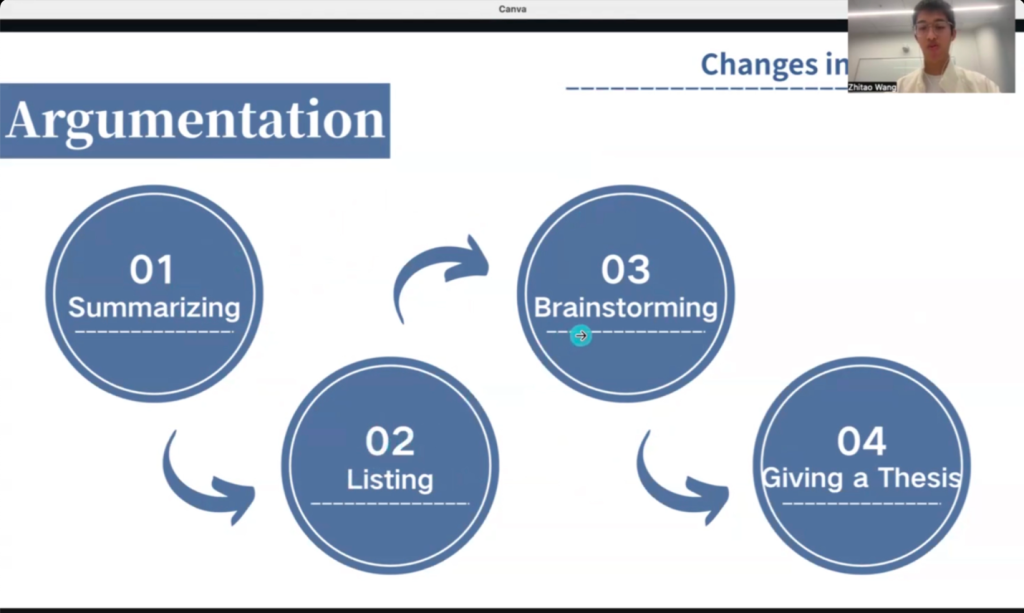
Screenshot 8. This shows a core step that the student demonstrated in connecting his reflection to his future goals in writing improvement and writing knowledge transfer.
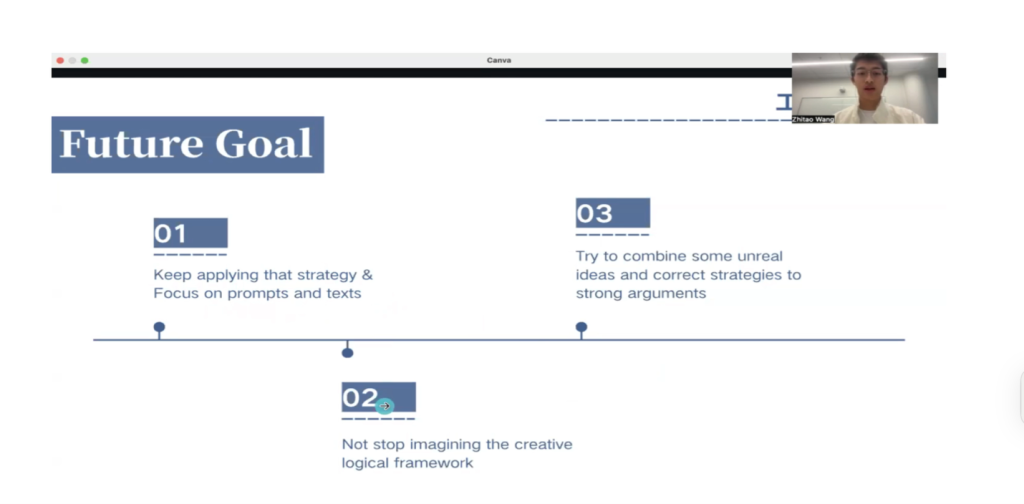
Teacher’s Reflection
As the teacher, I observed that the video reflection revealed more explicit metacognitive thinking than was consistently visible in the written reflective letters. In the videos, students appeared less preoccupied with the question “Did I get it right?” and more engaged with “Why did I revise in this way?” This shift suggests that the multimodal and oral format may create space for process-oriented thinking rather than product-oriented evaluation. Students were more likely to narrate their decision-making, articulate moments of uncertainty, and explain how they interpreted feedback or rubric criteria.
In addition, the oral format offered students a valuable opportunity to practice speaking in a low-stakes, low-anxiety context. Unlike formal presentations, these video reflections did not require polished performance; instead, they encouraged informal and conversational explanation. For some students, this appeared to reduce evaluative pressure and allow for more authentic engagement with their own writing processes.
At the same time, students’ levels of engagement were varied. William’s case represents a particularly successful example, demonstrating strong agency, ownership of revision decisions, and an ability to critically evaluate his own learning. However, other students approached the task more performatively. Some read directly from prepared scripts in front of the camera, and in these cases, the depth of reflection was often limited. Rather than analyzing their decision-making, they tended to summarize what they had done. This difference raises important pedagogical questions about scaffolding: How can we better support students in moving from descriptive recounting to analytical reflection? What prompts or modeling might help deepen metacognitive articulation?
Overall, I see the video reflection not only as a metacognition-oriented assessment but also as a pedagogical response to the growing risk that AI tools may replace rather than support students’ engagement with learning. By requiring students to explain their revision decisions, uncertainties, and evolving understanding in their own voice, the assessment shifts the emphasis from producing a polished product to demonstrating cognitive ownership of the writing process. Moving forward, I recognize that the effectiveness of this approach depends on how clearly I communicate its purpose: not as another performative assignment, but as a space where students are expected to account for their choices and actively engage with their own development as writers.
This is part of the collection of sharing from members of the 2025-26 Faculty Learning Community: Assessment in the Age of GenAI.