
The Value of Alternative Assessments in ECON 101 in the AI era
The rise of AI presents challenges to traditional assessment methods, as it creates new opportunities for automation and plagiarism while demanding more innovative, authentic, and interactive forms of evaluation. As part of an ongoing effort to explore innovative teaching methods, I modified two activies in my ECON 101 course: the Mind Mapping Activity and the Jigsaw Activity, to explore their potential for alternative assessment. These activities were designed to engage students in deeper learning, encourage metacognition, and foster peer collaboration.
ECON 101 is an introductory course designed to provide students with a foundational understanding of economic principles and concepts. About 70% of DKU freshmen students take this coures, and the majority of the students will not major in the economics track.
In my ECON 101, Mind Mapping aims to improve students’ ability to synthesize key economic concepts, while Jigsaw focuses on teamwork and peer learning. In this packet, I will provide an overview of both activities, share evidence of student engagement, and offer my own reflections on their effectiveness.
1. Mind Mapping Activity: Enhancing Metacognition
Objective:
The goal of the Mind Mapping Activity is to enhance students’ metacognitive awareness by having them visually organize the content covered in the first half of the course. This allows students to engage more deeply with the material, recognize connections between different economic concepts, and reflect on their learning.
Activity Overview:
- Date Scheduled: One week before the mid-term exam; 45-mins activity.
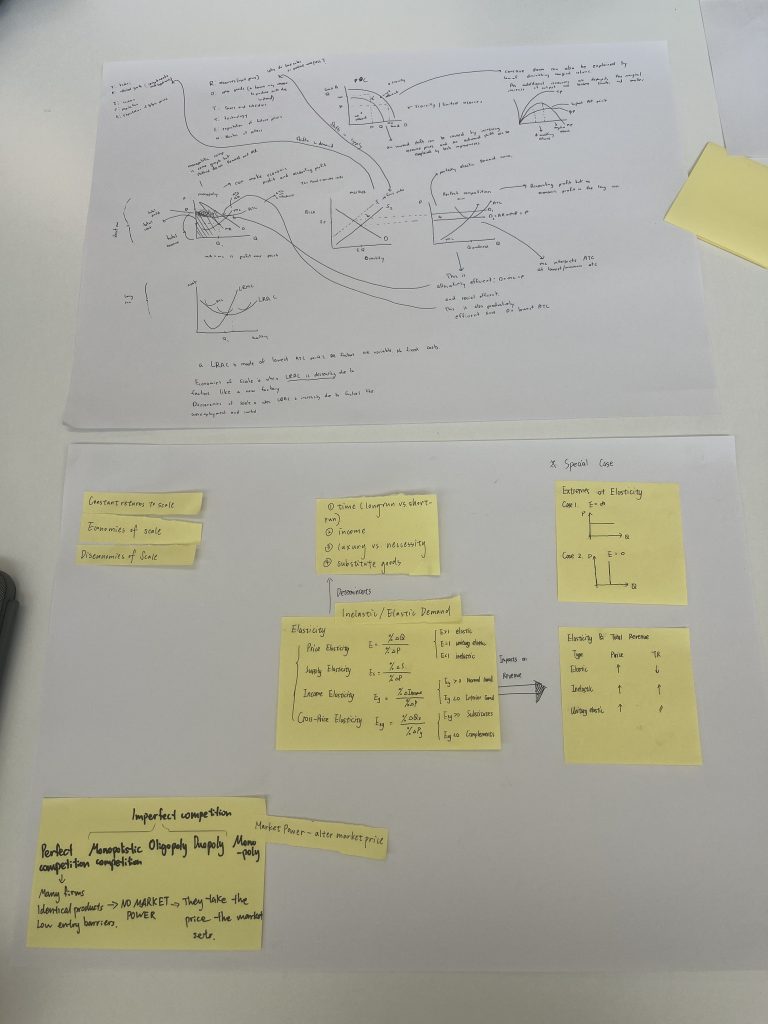
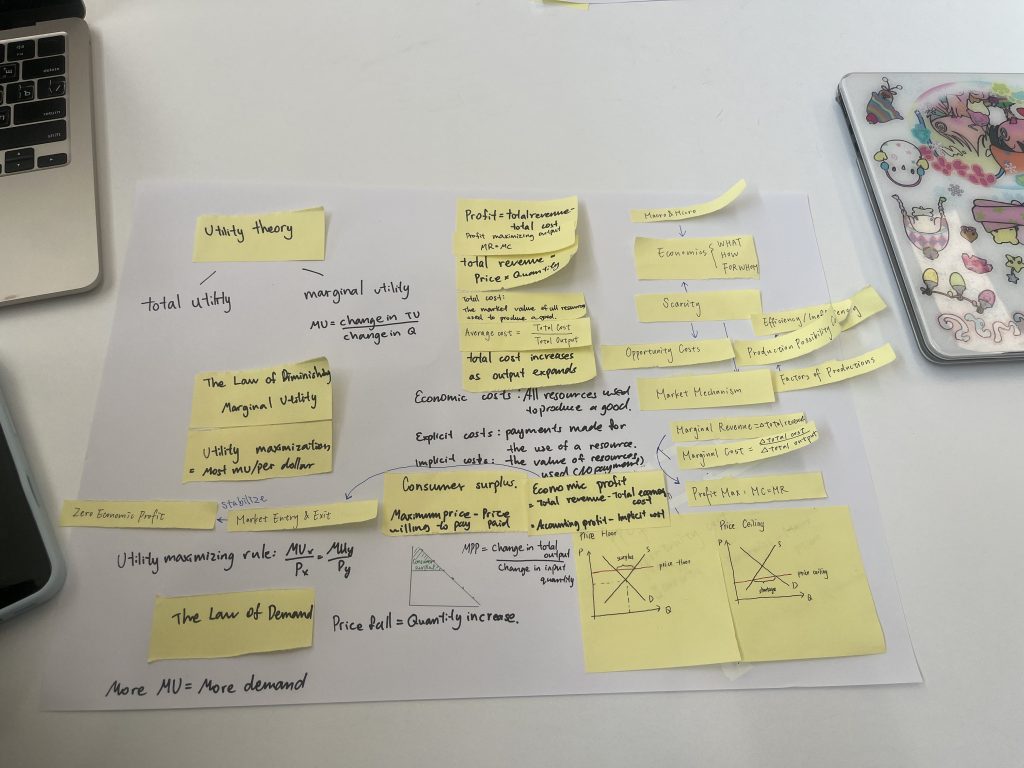
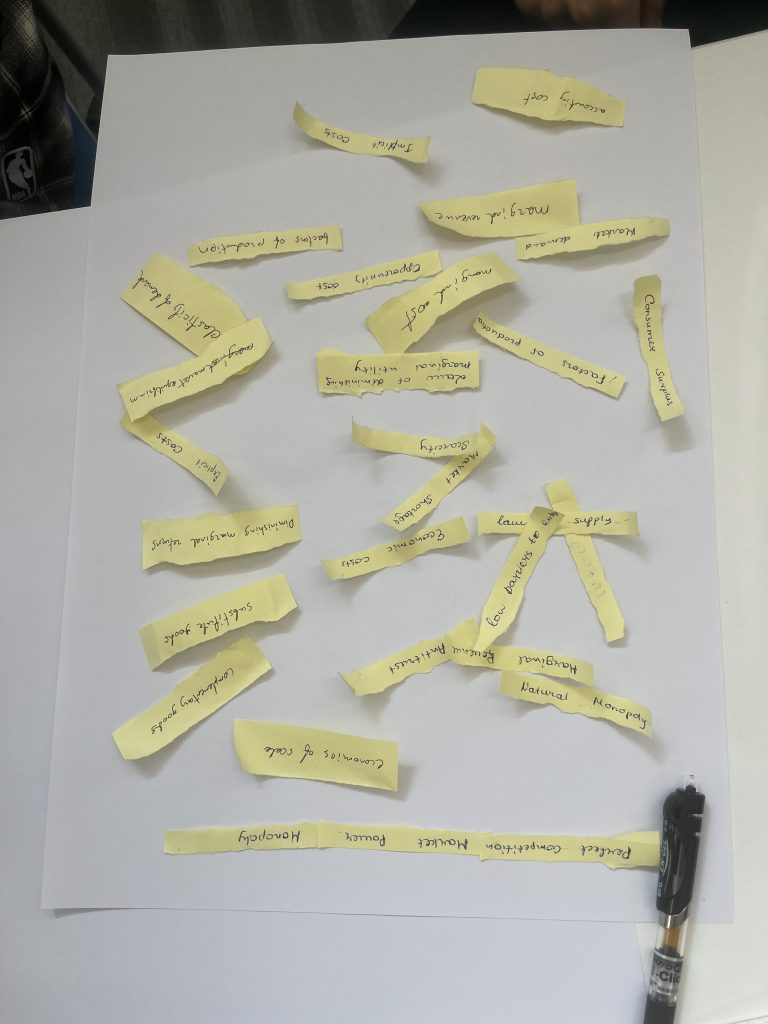
- Instructions: Students worked in groups to create mind maps with stick-it notes that captured the main themes, ideas, and interconnections between topics such as supply and demand, market structures, and elasticity. To ensure that students understood the process, I provided clear scald-folding instructions. I provide large sheets of white paper and stick-it notes. (Note: many students were unfamiliar with the term “scald-folding,” so I took the time to explain it in class.)
- Learning Outcome: The activity was designed to enhance students’ understanding of key concepts and introduce them to visualization of information.
Visual Evidence:
- Please see the photos of the sample mind maps below.
Student Reflections:
- “The class activities are also engaging. For example, the mind map making is interesting and helps my understanding of the framework together with my team members.”
Instructor Reflection:
The mind mapping activity was successful in helping students reflect on how concepts related to each other. By working in groups, students were able to discuss and refine their understanding of key terms. More importantly, I have observed that in this activity students rarely resorted to AI (they all have their electronic devices with them). The activity sets an example to the students of how the learning is taking place without AI. However, since the value of this activity lies in its proces, rather than the final product, I don’t think students should be evaluated/assessed. Rather, the engagement is part of course participation grade.
2. Jigsaw Activity: Promoting Peer Learning and Teamwork
Objective:
The Jigsaw Activity was designed to foster peer learning and collaborative problem-solving. It involved two components: the Expert Groups and the Home Groups.
- Expert Groups: Students were divided into groups, each assigned a different case related to course material. They worked together to produce a detailed case report.
- Home Groups: Each home group, consisting of members from different expert groups, first shared their expert knowledge, and then worked together to create quiz questions for this chapter.
Activity Overview:
- Date Scheduled: on the day when Macroeconomic measurement chapter is scheulded; 2.5hrs.
- Instructions: Expert groups produced a case report on their assigned topic, while home groups worked together to create quiz questions on the content they had learned from their expert group member. This encouraged cross-group collaboration and allowed students to teach each other about different parts of the course material.
- Learning Outcome: The activity was designed to promote critical thinking, teamwork, and active learning.
Visual Evidence:
- Please see Sample reports and quiz questions created by home groups (anonymized for privacy).
Student Reflections:
- “I understand that “students teaching each other“ is a good method, but it is always not as efficient as expected.”
- “However, from my own point of view, the class that we discussion the concept with classmates it’s a little bit unhelpful. Because the 7week schedule is tight, there’s so many concepts for this class, so I think the regular lecture is better.”
Instructor Reflection:
Speaking of the Jigsaw activity itself, the students are not used to peer learning, feeling that they would have learnt more in a traditional lecture. This observation is consistent with the literature. However, in Fall 2025 students responded even stronger – it might have to do with the modification introduced. The modification that I have introduced is to replace a quiz at the end of the home group sharing with creating their own quiz questions. Comparing Fall 2025 experiences with the past, having a quiz provided by the professor give students a certain level of assurance of how well they need to understand the material. Though the quiz questions they created are clear and accurate and they correctly identified the areas that are most prone to confusion, students don’t feel as confident in their performance compared to when they are engaged in a traditional lecture setting. It is importantn to incorporates elements to help assure the students in ways they are familiar anda comfortable with (especially with freshmen students who are just out of high school).
One further modification I will include is to use students’ quiz questions in their quiz and ask them to include why they find the questions important along with the quiz questions. The performance on the quiz – while seemingly traditional – will be part of the alternative assessment. This way, I could provide them motivation and also timely assurance.
This is part of the collection of sharing from members of the 2025-26 Faculty Learning Community: Assessment in the Age of GenAI.