
Authentic Assessment in the Age of AI: Writing, Journals, and Role Plays
During this Faculty Learning Community, I was thinking about Authentic Assessment and writing while teaching CC3. Here are some observations based on Ben VO’s CC3 assessment structure and some suggestions regarding how one could develop them further as writing assessments.
Handwritten Experience-Based Journals
- Handwritten journals based on conversations with interlocutors and the readings: these were quite successful, though graded pass/fail. Students analyzed their own experiences seriously in the context of the course, and it was inspiring to see them become self-reflexive in how they thought about the course concepts. Because they had to be specific about their lives, I found that very few seemed to turn to GenAI for assistance.
- For broader application, I would encourage courses to develop handwritten self-experience logs. If these are graded on a relatively simple scale (check plus, check, check minus), I believe that some of the anxiety that’s lessened by pass-fair grading will also be alleviated somewhat.
- To extend this type of assignment to other writing classes, students could be encouraged to write about a field trip, something they read or watched, or anything specifically related to the content of the course. Some sort of preparatory prompt or framing – in the case of CC3, a conversation – is important.
In-Class Role Plays + Writing
- As a class activity in CC3, I had students do multiple role plays. This activity was related to the ethics content of the course and also to the learning objectives of using conversation strategies, identifying similarities and differences between your own ethical viewpoints and those of others, talking about important questions in a way everyone can understand, and several others. Though these were an in-class activity, they could easily become an assessment.
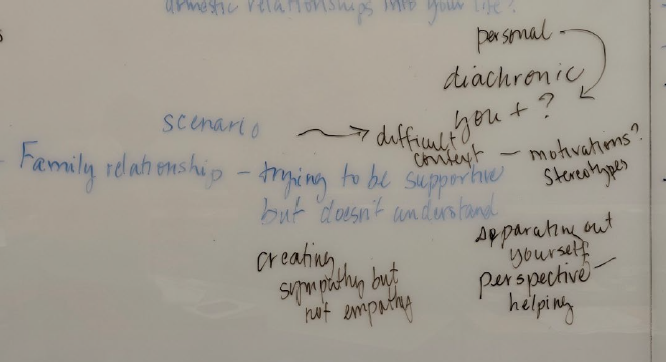
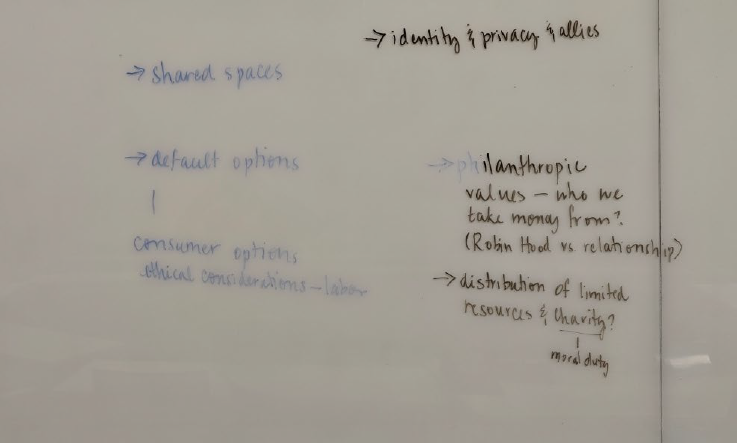
- Students were given a broad prompt that was aimed to produce listening and strategic communication instead of debate. Students worked in pairs. Here are the three scenarios I developed, which occurred in different classes during the course, followed by some of the white board discussion notes after the role play. Hopefully the white board notes will give you a sense of our debriefing and linking to course reading/concepts.
- I think it’s important for this debriefing to involve some discussion/critique of the format of the role-play itself, which you can see in the notes for Prompt 1, in which students critique how the role-play can default to “stereotypes.”
Prompt 1
- You are two family members (you determine your exact relationship, whether you are found family or natural family, etc. – the point here is not conflict but recognizing the validity of others’ values and supporting them). One of you has made a recent relationship change or choice. Maybe you’ve decided to get married, or you’ve decided against marriage, or you’ve come out as polyamorous. Try to get a little specific: maybe you are getting married young, or getting divorced because you are finding the practice of marriage too limiting for your own goals. Try to pick a situation that is different from what you would ideally choose for your own life.
- Your partner is trying to be supportive but you have different values, and they don’t really understand the change or choice. Have a conversation about it, then switch roles. You can come up with a new scenario if you want when you switch.
Prompt 2
- You are considering two very different career paths (you determine them). One career path looks like it will guarantee more stability and allow you to pursue some of your personal life goals, but you are less excited about the work. The other career path is more uncertain, but you know that if were to be successful, you would have great personal career fulfillment. Your friend is trying to talk you through some of the considerations.
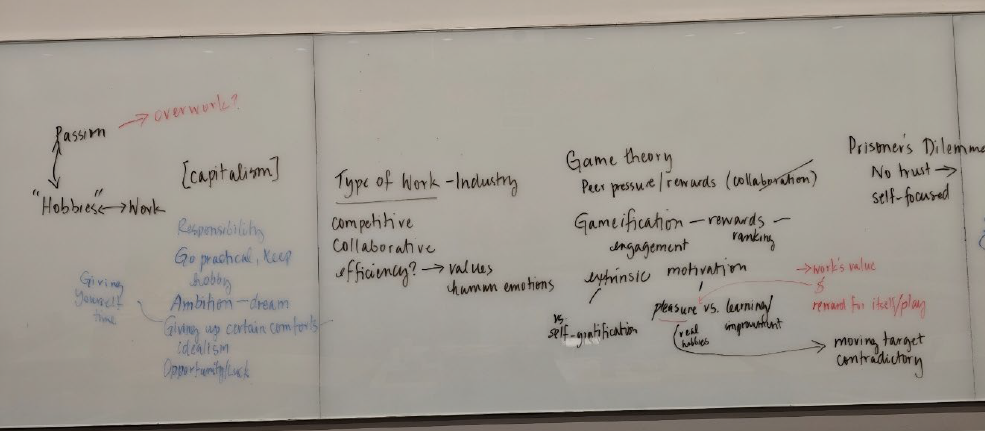
- With this one, I’m actually not sure where the role-play activity notes end and our class reading discussion notes begin – which I think is a good thing!
Prompt 3
- Come up with a scenario that creates a moral or ethical question.
- The stakes of the scenario should be lower than the ones in the readings.
- The scenario should imagine the specifics of a community where some people have more and some people have less – of something. What forms could this take?
- There should be a reason why it’s complicated or nuanced to help the community member(s) with less. Will it be perceived as unfair? Will it disadvantage the other community members in some way? Will it complicate relationships within the community?
- Role play two different roles in the community as you try to think through the scenario. You don’t have to be on opposing sides; you just have to be having a conversation about the options and challenges. Be as specific as possible.
Takeaways
- I believe that these sorts of role plays do not need to be performances or recordings that the instructor then assesses. They do not need to be observed. Instead, they can be authentic ways for students to work through real-world problems.
- In order to increase the writing component, students could do the role-plays in class and then write a short report (like a lab report) afterwards in which they discuss: the scenario and how they designed it; one way they would improve the scenario in order to make it more authentic; how they felt during the scenario; what communication strategies they learned during the scenario.
- Like with many in-class activities, students had mixed reactions to the role-plays. Some listed it as one of their favorite course components; others thought they felt unrealistic and forced. I believe that the learning objectives for role-plays, especially when including a writing assessment, need to be very explicit in order for students to see their value regardless of their personal reactions.
This is part of the collection of sharing from members of the 2025-26 Faculty Learning Community: Assessment in the Age of GenAI.