
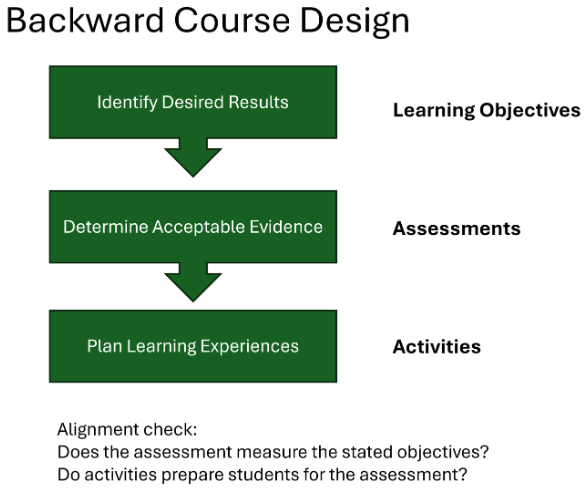

Backward Course Design is called “backward,” because it’s a process in which you:
- define clearly for yourself and your students, what students will know and be able to do by the END of your course (these are the course learning objectives).
- determine how students will demonstrate that knowledge and skill to you and themselves – what will you ask them in your course assessments?
- plan the course activities, exercises and instructional approaches you will need to include, in order to build students’ abilities from where they start to where you want them to end.
.
The core or backbone of your course, is the set of aligned learning objectives – assessments – activities that you design. From this backbone, you can plan how all the pieces will fit together over the 7 weeks of a DKU session, weaving in-class activities and out-of-class work to move toward your course objectives.
What Has Changed since GenAI
In an AI-rich world, students can generate polished products with minimal effort. This challenges assumptions that a finished product reflects individual thinking or understanding.
Rather than abandoning established design principles, we must apply them more intentionally. GenAI changes the tools available to students, but it does not change the core responsibility of course design: to foster meaningful learning and gather credible evidence of understanding. Clear learning objectives, aligned assessments, and structured learning experiences have become even more critical.
In this context, backward design requires us to clarify:
- What students must do independently
- What responsible AI collaboration looks like
- What counts as credible evidence of understanding
- How AI use is intentionally structured within learning activities

Rethink Learning Objectives
What do we actually expect students to learn? What essential knowledge and skills must they demonstrate independently?

Assessment
Research argues for structural assessment redesign that builds validity into assessment architecture rather than attempting to impose it through unenforceable rules.

Classroom Activities
Integrating GenAI in classroom teaching needs to be purposefully aligned with learning objectives and enhance student learning, rather than simply for novelty.