
Generative AI challenges a core assumption underlying many assessments: the final product reflects the student’s own understanding and capabilities. In the article Talk is cheap: why structural assessment changes are needed for a time of GenAI, Corbin et al. divide the responses to this challenge into two categories, discursive and structural approaches, and argue for structural assessment redesign that builds validity into assessment architecture rather than attempting to impose it through unenforceable rules.
Discursive Approaches
Discursive Approaches are defined as “Modifications that rely solely on the communication of instructions, rules, or guidelines to students, such that their success depends entirely on student awareness, understanding, and voluntary compliance with these communications.”
Examples include:
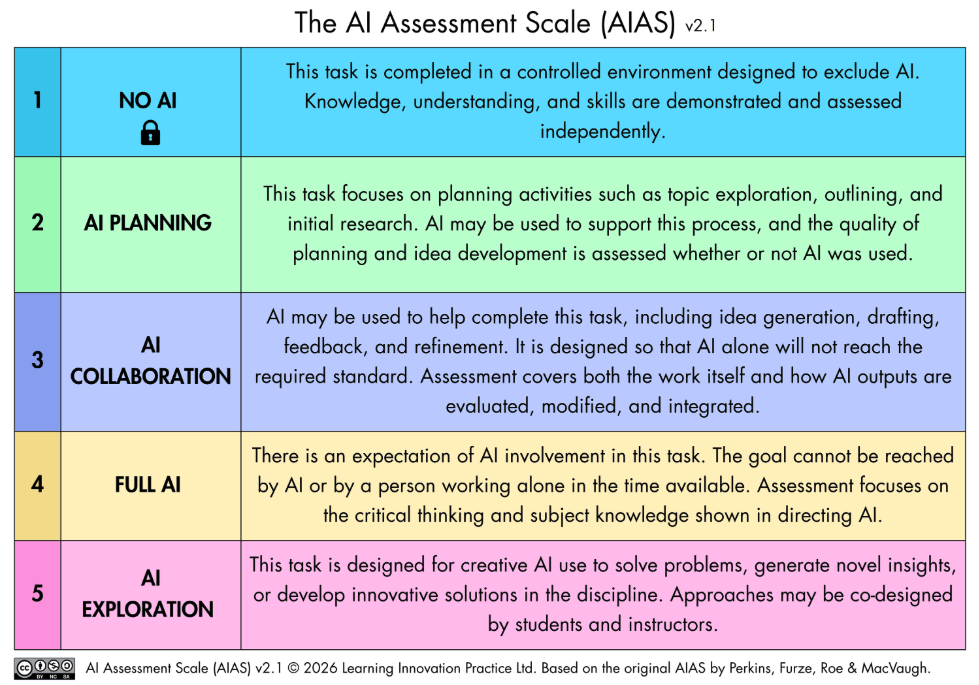
This is a three-tier categorization for using Gen AI in assessments.

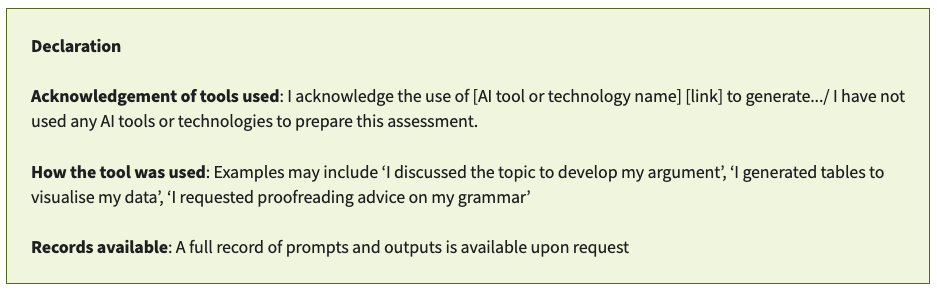
Many faculties have asked students to disclose AI use in assignments. For example, EAP (English for Academic Purposes) faculties at DKU prepare a coversheet for that purpose.
While these approaches can clarify expectations and raise awareness, their effectiveness ultimately depends on student interpretation and voluntary compliance. When assessment validity hinges on unenforceable rules about AI use, it becomes fragile. The central issue is no longer simply whether AI is used, but whether the assessment design still yields credible evidence of student learning. Because AI use cannot be reliably verified, rules alone are insufficient. This shifts our attention from regulating AI through policy to redesigning assessment structures so that validity is built into the task itself.
Structural Changes
Structural changes redesign the assessment itself so that meaningful evidence of learning is built into the task structure. Rather than attempting to control AI use solely through policies, structural approaches ask:
“What assessment design would still produce credible evidence of learning in an AI-rich environment?”
Here are some examples of structural changes from 2026 Assessment Redesign Framework
- Emphasizing Human Decision-Making and Justification
Assessment tasks should require students to explain, justify, and critique decisions made throughout the learning process, including decisions about whether and how AI tools were used. This shifts assessment from output generation to evaluation, judgement, and accountability.
- Designing for Process Transparency
Multi-stage, process-oriented assessments — including planning documents, annotated drafts, reflective commentaries, and oral explanations — make it more difficult for agentic systems to fully substitute for student engagement.
- Integrating Critical Reflection on AI Agency
Where AI tools are permitted, assessments can explicitly ask students to reflect on: What tasks were delegated to AI; What limitations or errors were identified; Where human judgement overrode AI-generated suggestions.
- Prioritizing Tasks Requiring Situated Human Context
Assessments that draw on lived experience, disciplinary interpretation, ethical reasoning, professional judgement, or contextual constraints remain less amenable to full automation.
- Maintaining Deliberate AI-Restricted Assessment Spaces
As agentic capabilities increase, it becomes increasingly important to retain some assessment contexts where independent human performance is required — to verify foundational knowledge, disciplinary understanding, and professional competence without AI mediation.
Two Lane Approach
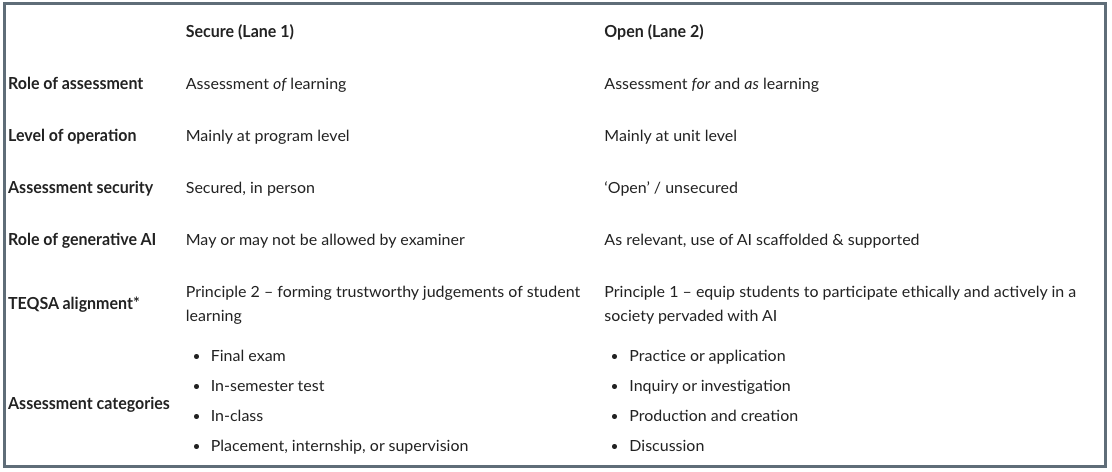
Many argue that making all assessments “AI-proof” is neither feasible nor necessary. Instead, assessment design can differentiate by purpose. For example, the University of Sydney’s framework treats summative and formative assessments differently—using more controlled conditions where verified demonstration is essential, while allowing greater openness and AI integration elsewhere. The focus shifts from prohibition to purposeful design aligned with assessment goals.
Student Motivation
Finally, even if we cannot fully detect or deter inappropriate AI use, assessment design can still shape student motivation. Rather than relying solely on control, we can design assessments that students want to engage with meaningfully.
Self-Determination Theory (SDT) suggests that students are more intrinsically motivated when three basic psychological needs are supported:
- Autonomy – a sense of choice and agency
- Competence – a sense of capability and growth
- Relatedness – a sense of connection to others
In assessment design, this implies:
- Support autonomy by offering meaningful choices (e.g., topics, formats, applications) and clearly communicating the purpose and real-world relevance of the task.
- Support competence by clarifying expectations, scaffolding complex work, and providing timely feedback that helps students improve.
- Support relatedness by incorporating collaborative elements, authentic audiences, community connections, and personalized feedback.
When assessments are purposeful, structured, and connected, students are more likely to invest effort in their own learning — regardless of the tools available to them.
Additional Resources
- Five Principles for Rethinking Assessment with Gen AI – Dr Leon Furze
- Sharing from DKU Faculty Learning Community 2025-2026: Assessment in the Age of GenAI: Faculty Learning Community 2025-2026 – Duke Kunshan Center for Teaching and Learning
- Readings shared through the 25-26FLC: Assessment in the Age of GenAI FLC Notebook – Google Docs