
- Promote responsible and ethical use of Generative AI
- Utilize AI tools to generate teaching and assessment materials and systems
- Guide students in using AI for academic, research, and creative work
What I did in the course and why
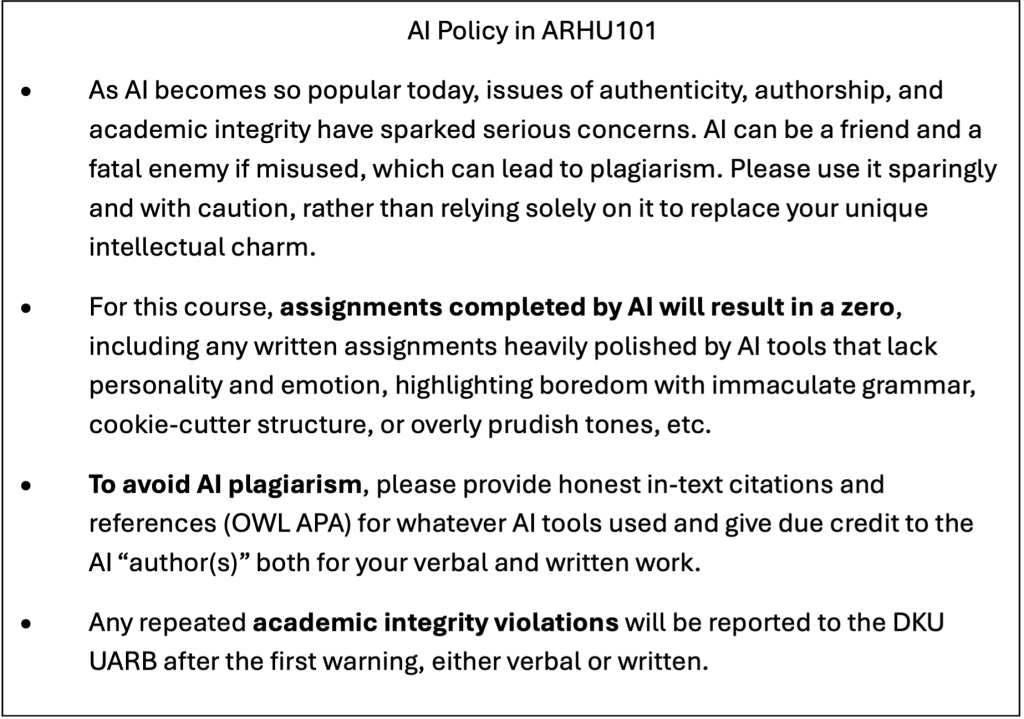
1) I consistently referenced the AI policy of our course (ARHU 101 The Art of Interpretation: Written Text) whenever relevant topics or issues arose and connected it to the university’s academic integrity standards. To help students understand, I often shared real-life examples of both intentional and unintentional violations of academic integrity related to AI use, along with their impacts on students’ and faculty members’ reputations and on teacher-student relationships. The resulting discussions helped students understand the rationales behind these policies and the cultural nuances in academia regarding honesty and plagiarism.
2) I used DKU ChatGPT and Perplexity to generate some of ARHU101’s assignments and teaching materials, including the 12 interpretive frameworks and 15 literary devices sheets, which helped students understand what these concepts mean and how they can apply them in their own textual interpretations.
Example:
3) I taught students how to use AI ethically and responsibly. Sometimes I demonstrated this by sharing what I did for my manuscripts, where the author was expected to attach an AI use declaration to the academic journal. This new change in today’s publishing process aligns well with my requirements for their written assignments.
Outcomes and Observations
- Some students learned to keep their personal voice in their writing when they are aware that authorial voice is essential in the arts and humanities.
- Some students began realizing that relying on AI can be a convenient trap, which may gradually weaken their quality communication skills that are particularly crucial for ESL learners.
- Some students pointed out the flaws of 3B (“bully, bias, bullshit” I learned and shared with them from one of the CTL workshops) in AI-generated content.
- Some students become very aware that AI should only be used for typo and grammar checks, and they should trust and be proud of their own voice and personal style.
Challenges and Lessons Learned
- Some students may dismiss AI policy as irrational and not aligned with the job market.
- Some students may perceive writing as an unnecessary skill since AI can do it better for them.
- Some students might use AI-generated content and modify it to sound more like human writing, then submit it as their own work. When encountering this, I always keep the options open, telling them they can send me the revision history as proof or provide explanations of what AI tool they used and how it helped with their work. It’s important not to stereotype students who use AI unintentionally.
- However, it can be challenging to determine whether a written work is original or not. I have mistaken original work for AI-generated and vice versa. Managing this extra task can be time-consuming and emotionally draining on top of regular teaching and grading.