
- Promote responsible and ethical use of Generative AI
- Utilize AI tools to generate teaching and assessment materials and systems
- Integrate AI tools for teaching specific content or skills
- Guide students in using AI for academic, research, and creative work
- Explore other innovative approaches related to AI in education
What I did in the course and why
In GLHLTH 205 (Social Determinants of Health) and GLHLTH 303 (Comparative Health Care Systems), I integrated artificial intelligence (AI) not only into student learning activities but also systematically into course design, instructional planning, and teaching preparation. The rationale was to use AI to enhance pedagogical effectiveness and curricular coherence while modeling for students how AI can be used responsibly and transparently in professional global health practice.
At the course design and preparation stage, AI tools were used to support syllabus redesign, learning outcome alignment, and assignment scaffolding. For both courses, AI assisted in mapping course learning objectives to weekly topics, identifying where AI-supported activities could meaningfully strengthen analytical or civic learning goals, and refining rubrics to assess both substantive content and students’ ethical use of AI. In GLHLTH 303, AI was used to help structure comparative health system modules and policy analysis frameworks, ensuring consistency across country cases while allowing flexibility for student-selected contexts. In GLHLTH 205, AI supported the design of CHNA-related assignments by helping generate structured prompts, draft data collection templates, and reflection questions aligned with socioecological and civic engagement frameworks.
In teaching preparation and instructional support, AI was used to assist with lecture planning, case development, and the preparation of examples and discussion prompts. For example, AI helped generate comparative policy scenarios, summarize complex health system reforms for instructional use, and create alternative explanations or visual outlines tailored to students with diverse disciplinary backgrounds. These uses improved instructional efficiency and allowed more faculty time to be devoted to mentoring, feedback, and community partnership coordination.
At the student learning level, AI was intentionally embedded into assignments and activities. In GH 205, students used AI to support background research for community health needs assessments, refine interview guides, synthesize qualitative field notes, and explore data visualization options, with explicit instruction on verification, ethical boundaries, and reflexivity. In GH 303, AI supported comparative literature reviews, cross-country system mapping, and policy brief drafting, with required documentation and critical evaluation of AI-generated outputs.
Across both courses, AI was framed as a pedagogical tool, an analytical aid, and a subject of critical inquiry. By integrating AI into course design, teaching preparation, and student assessment, the goal was not only to improve learning efficiency, but also to cultivate students’ capacity to evaluate AI’s role in shaping global health evidence, policy reasoning, and civic responsibility.
Examples (NetID Log-in):
Outcomes and observations
Several positive outcomes emerged from this AI-integrated approach.
First, student engagement and confidence increased, particularly among students who initially struggled with large volumes of academic literature or complex policy documents. AI-assisted drafting and summarization helped lower entry barriers, allowing students to spend more time on higher-order tasks such as interpretation, critique, and application to real-world contexts.
Second, the quality of student outputs improved in structure and clarity, especially in comparative analyses, policy memos, and CHNA reports. Students demonstrated stronger ability to synthesize evidence across sources and articulate multi-level determinants using socioecological frameworks. When paired with reflection requirements, many students showed growing awareness of AI’s strengths and limitations, including issues of bias, data representativeness, and overgeneralization.
Third, AI integration supported deeper civic learning in GH 205. By using AI to handle preliminary research tasks, students were able to focus more intentionally on community voices, photovoice storytelling, and translating findings into locally relevant recommendations. Several student reflections indicated that AI helped them feel more prepared and less overwhelmed when entering community fieldwork.
However, outcomes were not uniformly positive. In some cases, over-reliance on AI led to surface-level analysis, particularly early in the semester. This highlighted the need for continuous reinforcement that AI-generated content is a starting point, not an endpoint, for academic and civic inquiry.
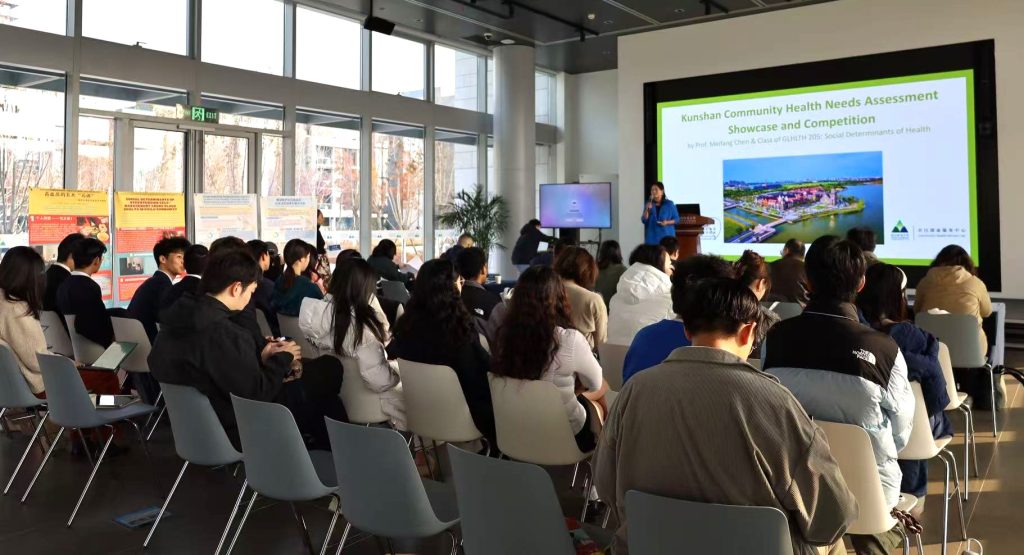
GLHLTH205 Kunshan Community Health Needs Assessment Showcase and Competition, Fall 2025
Prof. Meifang Chen introduces the process and judges who were DKU members and Kunshan community partners from municipal offices and local clinics.
Challenges and Lessons Learned
A key challenge was uneven student readiness and AI literacy. Students varied widely in their prior experience with AI tools, critical evaluation skills, and understanding of ethical use. This required additional instructional time to establish shared norms, provide examples of appropriate versus inappropriate AI use, and revise rubrics to assess both process and reflection, not just final products.
Another challenge was the increased instructional and feedback burden. While AI helped students work more efficiently, it did not automatically reduce faculty workload. In large classes, it became difficult to provide timely, individualized feedback on how students were using (or misusing) AI in their analytical process. This highlighted the need for institutional support, such as shared AI literacy modules, teaching assistants trained in AI-supported assessment, or approved tool guidance at the program level.
Overall, this experience underscored that AI can meaningfully enhance global health education when intentionally designed and ethically framed; but without clear guidance and institutional alignment, it can also undermine learning goals and assessment validity. Future iterations will benefit from more standardized AI literacy support, clearer program-level policies, and shared teaching resources to ensure AI strengthens, rather than distorts, educational practice.