
Providing Guidance for the Homework Questions with the Assistance of GenAI
I taught PHYS 121 Integrated Science-Physics (a divisional foundation course capped at 40 students (39/40), about 30% were juniors and seniors this time) and PHYS 201 Optics and Modern Physics (a disciplinary course for Materials Science/physics and Molecular Bioscience/biophysics, capped at 24 students (16/24), 2 sophomores and 1 PG student, the rest were juniors and seniors) in session 2, Fall 2025. Both courses have heavy content, and equivalent ones at Duke. One thing I noticed recently was that the average score of the homework (HW, weekly) part was much higher than the exams (midterm and final), which was similar in other PHYS 121 sessions taught by different instructors. I feel that the use of AI tools in assisting, hopefully not replacing, in completing the homework by students is unavoidable. A couple of things I did in that session was to use ChatGPT to redesign the homework questions for including intentionally embedded scaffolding procedures, mostly, by providing guidance and hints within the questions, so that most of the students could finish or try to complete the homework by themselves, and may ask for double checking by AI tools (or talk to other students, peer tutors, etc.) before they submitted the homework for grading. Additionally, I asked ChatGPT to include ‘drawing’ questions whenever possible (ChatGPT was not good at generating this kind of drawing yet). At the same time, I put the following statement at the end of each homework for which students might get a little bonus if they included detailed descriptions about the AI tool usage.
Note: As mentioned below, students submitted a PDF version of their homework to Gradescope, an online grading platform, where the TA will grade the homework (briefly checked by me). For the midterm/final exam, I would scan all students’ exam papers and upload them to Gradescope too. Typically, the initial feedback was released to students on Gradescope within 48 hours after the deadline.
[Guidance at the beginning of HW 1]
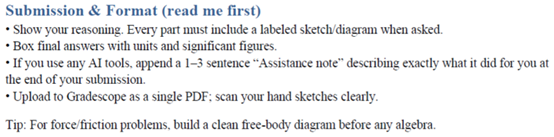
[Note at the end of each homework]
Here are some examples of the ‘Assistance notes’ students provided (reworded):
“I asked ChatGPT for ‘In physics, give citation to this’, https://www.xxxx for proper citation.”
“I used ChatGPT for giving me the definitions and references”
“I used AI to clarify the Problem 1, 4 for me to understand what the question is”
“I search and cited the Bonus question through AI”
“LLMs are used as translators, brainstorm-assistants during the work. No direct words from LLM was taken.”
“AI tools are used for explaining problems with unclear wording, assisting in calculation, and verification of answers.”
“Q1 was done with assisted by ChatGPT by providing formula and its explanation. The homework answer was written with my personal understanding after learning from AI’s reply.”
Here is an example of the revised question:
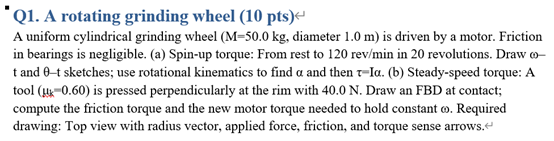
Here was the original question:

Previously, I did not ask students to draw the w-t or -t curves explicitly, but put a statement at the beginning, saying that ‘a sketch to illustrate the physics process is always helpful’. Most of the students did not draw sketches. But when it was part of the grades, most of the students did draw sketches.
I should note that the big difference between the performance in homework and exams still existed in the two courses I shared here (no quantitative conclusion was made yet). One thing I plan to do (the idea came up during a physics teaching cohort meeting) is to give students a ‘second chance’ for choosing a question from the midterm exam, ask an AI tool to answer the question, compare with their original answer, write a reflection including ways to improve the performance in the final exam (maybe how to better use AI tool for assisting his/her learning). By doing so, they may get 60% of the lost points of that question back.
If you would like to try similar things in your teaching, you may ask ChatGPT or other AI tools to answer the questions and get a taste of what kind of answers students may get. Of course, always proofread everything generated by AI tools before releasing to students.
This is part of the collection of sharing from members of the 2025-26 Faculty Learning Community: Assessment in the Age of GenAI.