
By Mengyu Ma
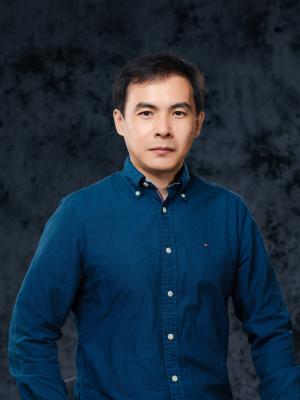
At Duke Kunshan University (DKU), faculty continually explore innovative ways to respond to the opportunities and challenges that generative artificial intelligence (GenAI) brings to higher education. Among them, Dr. Yachao Sun, Assistant Professor of Applied Linguistics and Writing Studies, has emerged as a leading voice in helping students and educators rethink what it means to write, learn, and think critically in the age of AI.
Prof. Sun has taught academic writing courses that help students develop their research writing skills at DKU and at two universities in the United States. His research also examines how applied linguistics and writing theories can address the challenges of increasingly diverse teaching and learning contexts amid rapid technological change, thereby informing contemporary language practices and pedagogies.
By engaging students in discussions about boundaries and emphasizing the importance of reflecting on the use of GenAI tools, Prof. Sun models a pedagogy that places human creativity, judgment, and autonomy at the heart of learning. His approach reflects the spirit of DKU’s liberal arts tradition, bridges innovation with reflection, and offers both faculty and students a pathway to navigate an AI-enhanced academic future with integrity and purpose.
No reason to refuse GenAI: Students’ behaviors and perceptions are changing
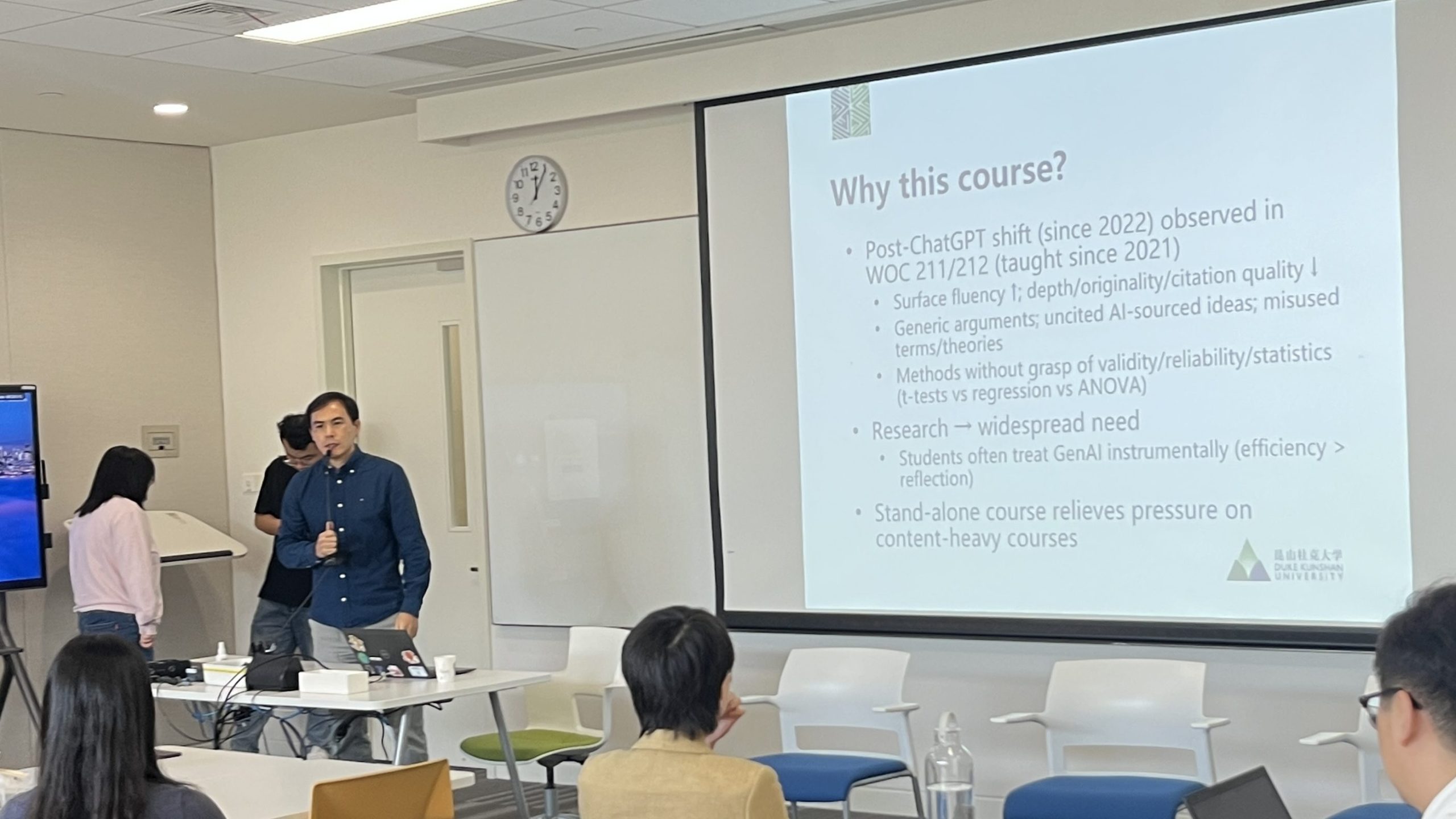
Prof. Sun’s ongoing research and teaching experience often makes him the first to notice even subtle changes in students’ academic writing behaviors and performance, especially since GenAI has become an easily accessible tool for DKU students. More specifically, student writing has become more fluent on the surface, yet often includes uncited ideas, terminologies they cannot explain, and complicated methods lacking validity, reliability, or even basic statistical grounding. Though many faculty have quickly responded to this shift by revising course policies or redesigning assignments, students still use GenAI instrumentally as a tool for efficiency, convenience, and fluency.
Prof. Sun’s recent study (Sun & Lan, 2025), published in System, further illustrates this phenomenon. Surveying 320 Chinese undergraduate and graduate students who write academically in English, he found that participants held moderately positive beliefs about GenAI’s ability to improve their academic English writing, and moderate agreement that it could enhance their critical thinking and analytical skills. These findings imply that today’s students increasingly view GenAI as a potential tool for developing cognitive skills.
Admittedly, GenAI tools can provide immediate feedback, inspire new ideas, and support individualized learning needs. But, as Prof. Sun and many faculty around the world believe, effective writing is not just about producing grammatically correct sentences. It is about demonstrating critical thinking, creativity, and writers’ unique voices. Research also shows that collaborating with large language models (LLMs) can lead to decreased human creativity in complex tasks (Cheng & Zhang, 2025), a finding that aligns with these concerns.
All these insights have inspired Prof. Sun, as an educator, to explore pedagogical approaches that help students use GenAI tools more effectively while also preserving human creativity and autonomy. He has put his research and ideas into practice by offering a new course at DKU: WOC 111 GenAI and Writing.
Developing Student Critical AI Literacy by Having Them Write about It
As an academic writing course, students learned how to craft strategic database search queries, evaluate the reliability of sources, construct well-supported arguments, cite accurately, and conduct ethical primary and secondary research in this course. What distinguishes Prof. Sun’s approach is that he integrates GenAI tools into the process of learning each of these skills. When Prof. Sun’s first-year students directly engage with these tools and gain firsthand experience of how GenAI can fake sources and present biased perspectives yet make them plausible and sophisticated, they begin to demystify its role in academic work.
Because the course is designed around GenAI, students also learned prompt engineering, compared different GenAI tools, experimented with prompts in different languages, examined cultural differences across tools, and discussed the impact of misuse and overreliance. Together, these activities deepened students’ awareness that GenAI carries both affordances and limitations, which arises from how it learns from inherently biased human input, how it aims to please users rather than remain objective, and other “by-design” factors.
However, putting awareness into practice is more important. In Prof. Sun’s class, students unpacked what it means to “use GenAI responsibly and ethically” by negotiating boundaries and following shared guidelines. They used GenAI to plan content or organize notes for oral reports and presentations while maintaining their own original ideas. They verified AI-generated claims through reliable databases and research findings. They also demonstrated stronger judgment in their writing by respecting authorship and taking a more holistic perspective.
Furthermore, Prof. Sun deepens his cultivation of students’ critical AI literacy by asking them to write a short reflection on their learning throughout the course.
“Provide a concise, narrative reflection on your experiences and learning trajectory in the course, explaining how your understanding of the responsible, ethical, and effective use of GenAI for academic writing has evolved, what matters most to you in academia, what you still need to learn, and how these skills will support your work in other courses and your future academic career.”
Surprisingly, as freshmen who had entered college only two months earlier, Prof. Sun’s students reflected:
“My biggest takeaway from this class was not about AI. It was (about) a reflection of myself. It was (about) how I think, how I write, and how I question technology instead of just using it. Ethics is not just (in) a philosophy class. We make the ethical and conscious decisions every single day when using AI. We are shaping how knowledge is created and shared.”
“The real question is not (about) whether we (should or) should not use AI, (it is about) the purpose of our writing or how we can use AI in a more productive way. It is crucial to continue exploring how AI can support writing in various contexts, always prioritizing the balance between technological advancement and human cognitive engagement.”
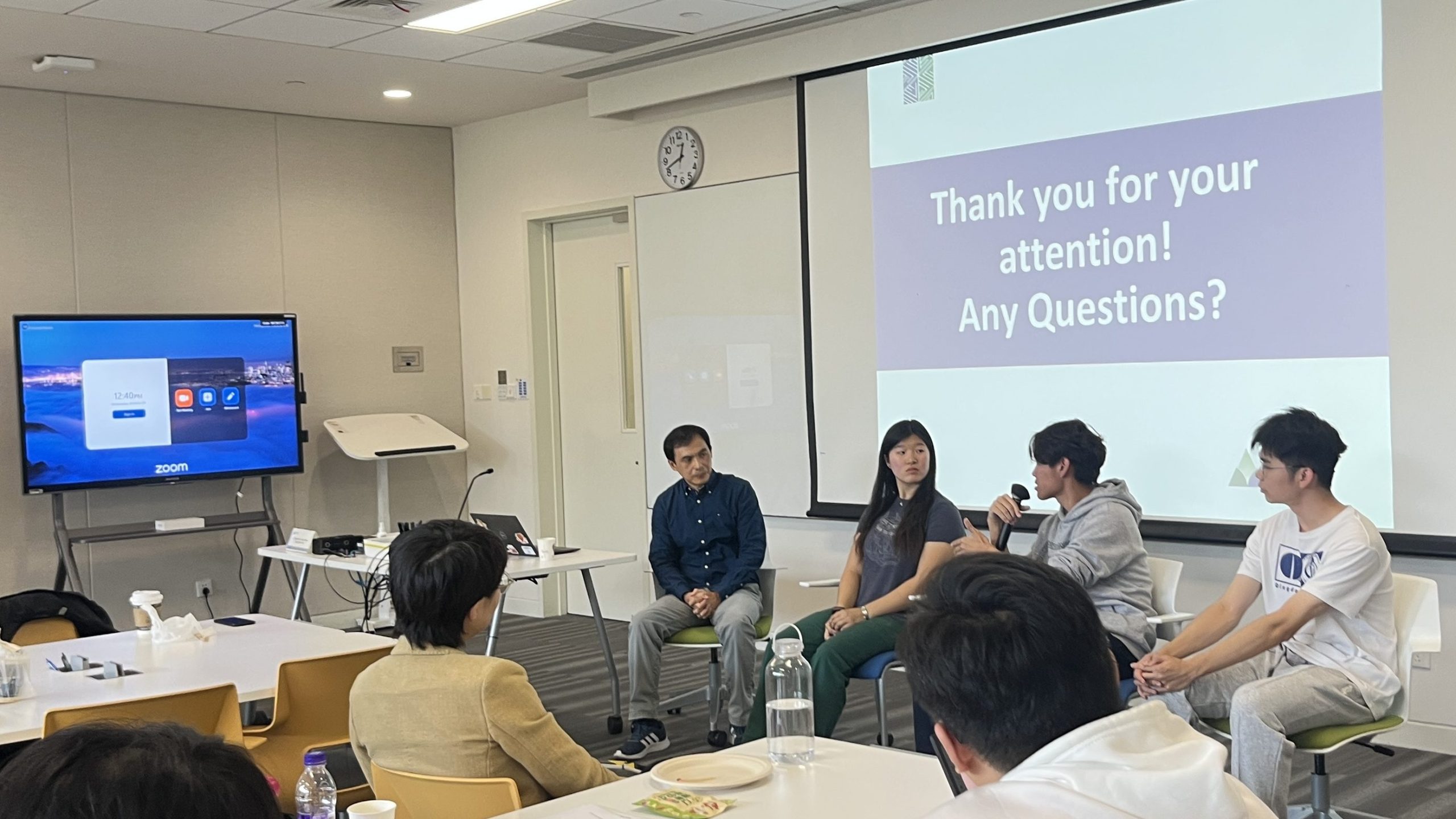
By guiding students to see both sides of GenAI, discuss its impacts and consequences, practice responsibility and ethics, and reflect on their learning process, Prof. Sun strengthened students’ critical AI literacy through carefully designed instructional activities and the intentional development of metacognition to close the loop.
Promoting Self-regulated Learning and Student Autonomy is the Key
As a linguist and writing instructor, Prof. Sun has the privilege of designing and teaching a dedicated course. But behind the course itself lies his deeper goal of fostering students’ self-regulated learning and developing their autonomy. Having observed students move from using GenAI-fabricated references to support their arguments to posing sharper questions and offering thoughtful comments on peers’ claims, Prof. Sun believes that encouraging students to take ownership of their learning and engage critically with GenAI helps them build confidence, autonomy, and a more inquiry-driven approach to learning. When students learn to take initiative, monitor their own progress, and reflect critically on their learning, they become better equipped to apply knowledge and skills effectively. In this sense, self-regulated learning enhances the development of specific knowledge points and writing abilities.
Self-regulated learning often refers to an active and constructive process where learners employ strategies to control, regulate their cognition and behaviors in order to achieve their goals (de Boer, Bergstra, & Kostons, 2012; Martínez-López et al., 2023). In a meta-analysis on effective instructional strategies for self-regulated learning, de Boer et al. (2012) found that teaching students when, how, and why to use learning strategies has a positive effect on their reading and writing performance. Specifically for writing, teaching students to reflect on their task completion process or evaluate their final product also has a positive effect on performance. In addition, the analysis suggests that teaching practices that help students plan how they will perform a task and what they will need to perform well, as well as those that help students recognize the relevance and importance of a task, are among the most effective ways to enhance student performance.
The research findings and Prof. Sun’s teaching philosophy converge on the same idea: the rapid integration of GenAI into learning makes student autonomy and metacognition more important than ever. Encouraging students to discuss their use of GenAI in academic contexts and to write about those experiences strengthens human autonomy and reinforces students’ critical thinking.
To give a fuller picture of the study by Cheng and Zhang (2025) mentioned earlier, their findings also revealed that constraining the output of LLMs can effectively enhance creative performance in complex tasks. For users who are not able to control how and what LLMs generate, strengthening students’ critical AI literacy and guiding them toward self-regulated learning offer meaningful ways forward.
References
Cheng, X., & Zhang, L. (2025). Inspiration booster or creative fixation? The dual mechanisms of LLMs in shaping individual creativity in tasks of different complexity. Humanities and Social Sciences Communications, 12, 1563. https://doi.org/10.1057/s41599-025-05867-9
de Boer, H., Bergstra, A., & Kostons, D. (2012). Effective strategies for self-regulated learning: A meta-analysis. Groningen: GION onderzoek/onderwijs.
Martínez-López, E., Nouws, S., Villar, E., Mayo, M. E., & Tinajero, C. (2023). Perceived social support and self-regulated learning: A systematic review and meta-analysis. International Journal of Educational Research Open, 5, 100291. https://doi.org/10.1016/j.ijedro.2023.100291
Sun, Y., & Lan, G. (2025). Enhancing critical language awareness in EAL writing education amid the rise of generative artificial intelligence. System, 134, 103806. https://doi.org/10.1016/j.system.2025.103806