
Bloom's Taxonomy Revisited
Bloom’s Taxonomy organized cognitive skills in a hierarchy from lower-order to higher-order thinking: Remember → Understand → Apply → Analyze → Evaluate → Create. Generative AI has changed or even turned this hierarchy upside down in surprising ways. GenAI systems often excel at what Bloom considered “higher-order” skills like creation, evaluation, and analysis, while frequently failing at “lower-order” abilities like recalling well-known facts or applying simple concepts.
Rather than abandoning Bloom’s Taxonomy entirely, educators are reimagining it to emphasize iterative learning cycles of judgment, critique, and synthesis. The focus shifts from a linear hierarchy to understanding which tasks require distinctly human cognition versus which can be AI-assisted.
Examples of the revised versions of Bloom’s Taxonomy (Click pics to know more)
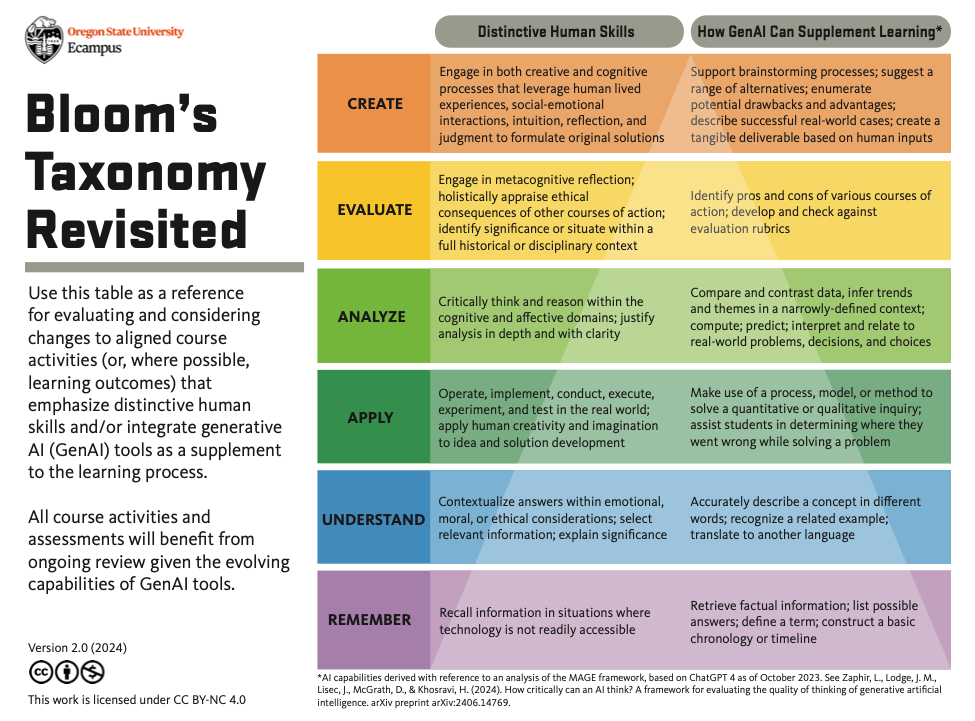
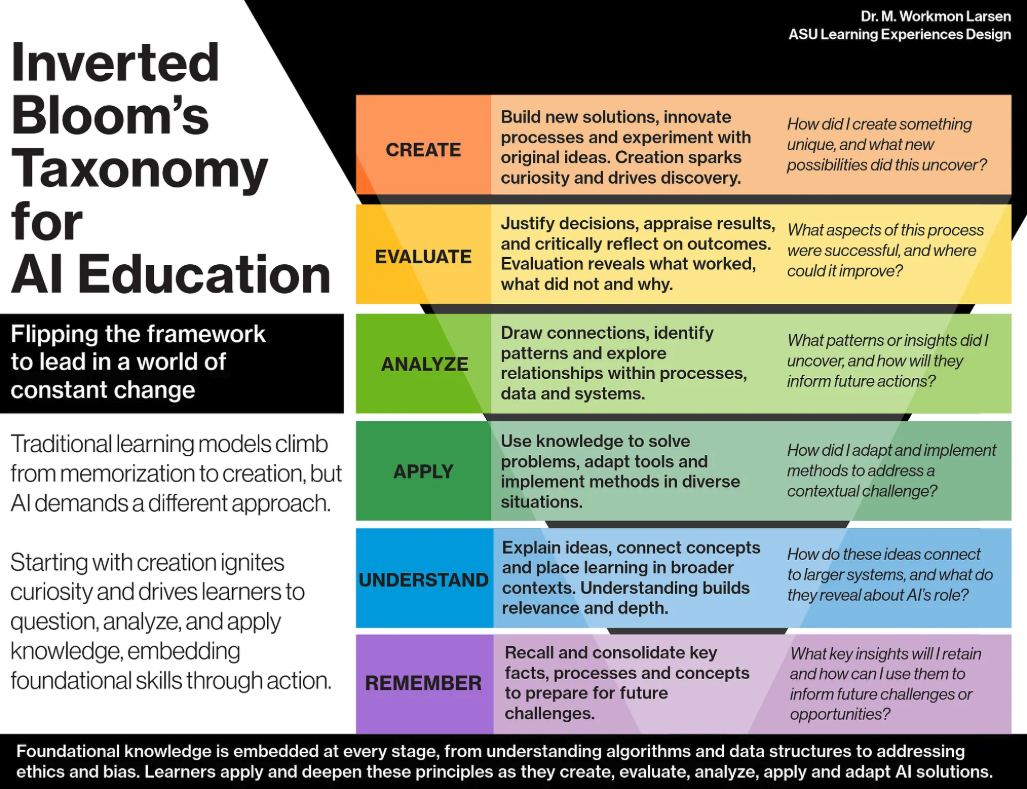
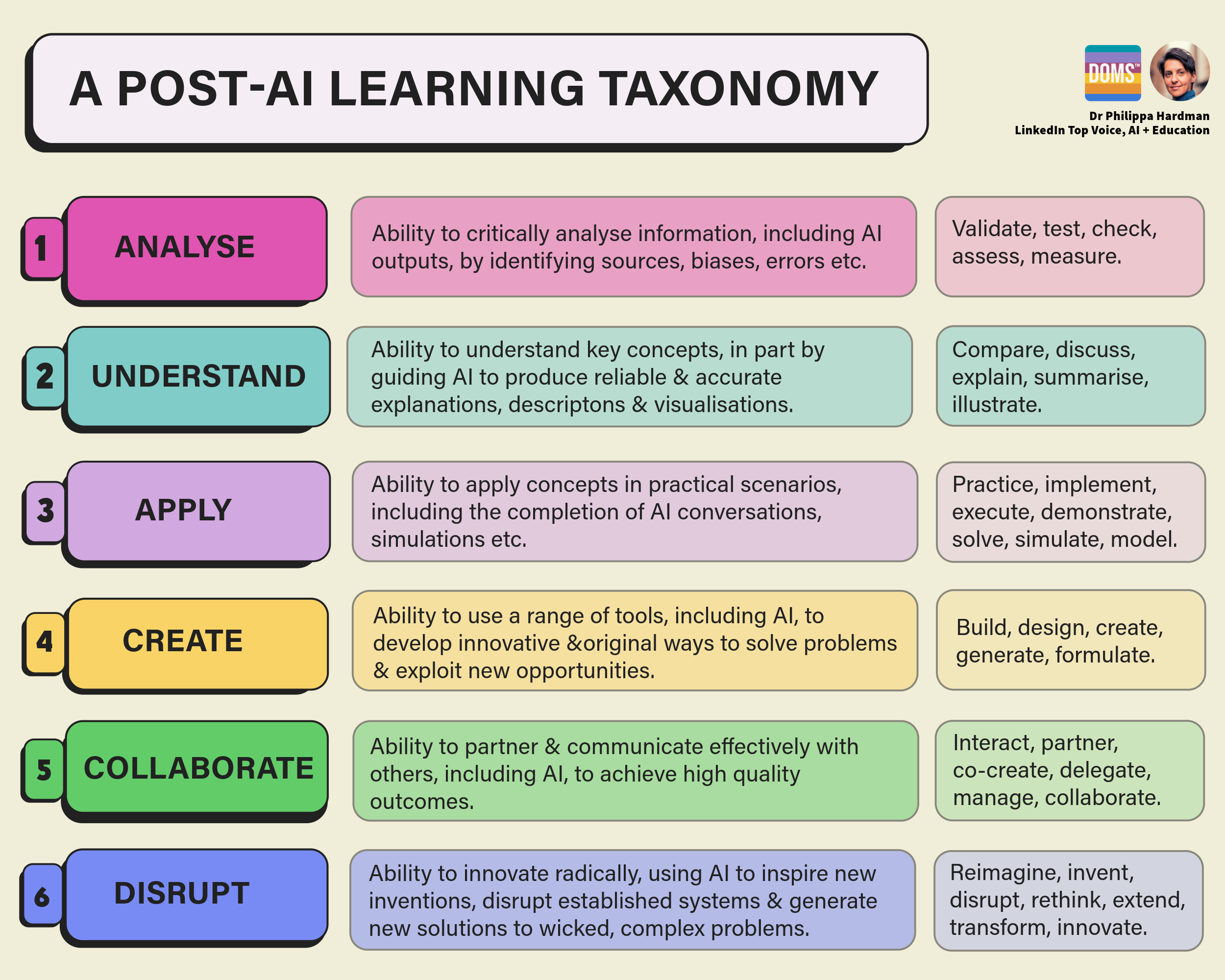
The key shift is identifying which cognitive skills remain uniquely human. Educators now emphasize:
- Metacognitive reflection and ethical judgment
- Creative processes leveraging lived experiences and social-emotional interactions
- Critical thinking within moral and emotional contexts
- Real-world experimentation and implementation
GenAI can support these processes by brainstorming alternatives, comparing data, or checking work, but it cannot replace human intuition, contextual understanding, and ethical reasoning.
Review Your Course Learning Objectives
Nowadays, instead of simply asking “What should students know and be able to do by the end of the course?” we need to clarify:
- What must students be able to do independently?
- What should they be able to do effectively with AI?
What must they understand about AI’s role and limits in the discipline?
Below are some concrete ways to rethink objectives when designing or redesigning a course:
1. Decide what must remain “human work”
For each existing objective, ask two questions:
- Could a student meet this objective today by mostly prompting GenAI
- Even if yes, is it still important that they can do this without AI, or is the real goal now “doing this with AI well and responsibly”?
2. Add explicit “AI fluency” objectives that are relevant to your course
Working effectively with GenAI is a teachable and assessable skill. As AI becomes integral to professional practice, preparing students to use it thoughtfully is essential.
Common new objective types:
- Tool‑aware objectives
- “Identify appropriate GenAI tools for (a given task in your course) and justify the choice.”
- Critical‑thinking‑with‑AI objectives
- “Evaluate the reliability, bias, and limitations of GenAI outputs using (some disciplinary criteria).”
- Ethical and equity objectives
- “Articulate ethical considerations (privacy, plagiarism, bias, labor) in the use of GenAI in (your discipline).”
3. Make objectives more process‑based and visible
Learning objectives need to be measurable. Because AI can produce polished products quickly, objectives should target visible processes, not just end results. For example, a more process-visible alternative to “students will be able to solve complex physics problems” will be
- Students will be able to select appropriate problem-solving strategies and justify their choices.
- Students will be able to explain assumptions, limitations, and trade-offs in proposed solutions.
- Students will be able to interpret quantitative results in relation to real-world constraints.
Resources
Human Wisdom for the Age of AI: A Field Guide to Cultivating Essential Skills
- This guide, by AAC&U and Elon University’s Imagining the Digital Future Center, is designed to help students develop the human capabilities needed to navigate a digital world. It proposed 10 human capacities with a teacher’s guide for each one.
.
AI Skills Opportunity Map – Preparing the Next Generation Workforce
- This is a report by the Digital Education Council analyzing how AI is transforming professional work across 11 job families and what institutions and employers must now do differently.